 gabriel m.
- PinkGoldPeach23
- JIRAUSER701849
- Europe/Stockholm
- Yes
- No
 MC-240393MC-241029
![[Mojang] Adrian Östergård](../../../data/assets/gravatar/nighter.jpeg)
![[Mojang] elvendorke](../../../data/avatars/users/81677.png)









Lush caves
Windows 10
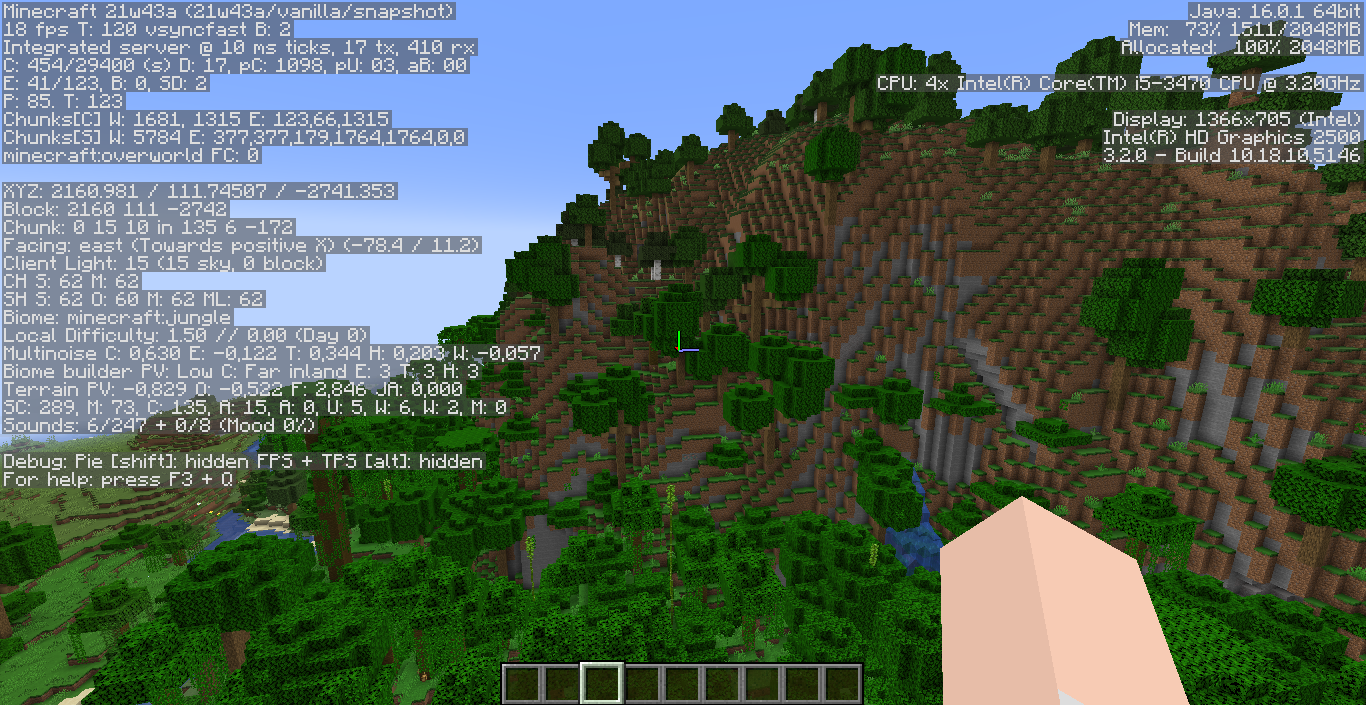
Forest biomes seem to generate on hilly areas when both the T (temperature) and H (humidity) noise values are 3. On non-hilly terrain at these T and H values jungles and sparse jungles generate, while forests only generate when humidity is 2, but in hilly areas where humidity is 3, they still generate and replace jungles, which not only looks a little out of place but also creates microbiome issues
andmakes the forest biome too common.
By looking at these images, it's possible to see that the T and H values in the biome builder line in the debug screen don't change.
Forest biomes seem to generate on hilly areas when both the T (temperature) and H (humidity) noise values are 3. On non-hilly terrain at these T and H values jungles and sparse jungles generate, while forests only generate when humidity is 2, but in hilly areas where humidity is 3, they still generate and replace jungles, which not only looks a little out of place but also creates microbiome issues, makes the forest biome too common and restricts the jungle and sparse jungle biomes from generating in hilly areas.
By looking at these images, it's possible to see that the T and H values in the biome builder line in the debug screen don't change.
Forest biomes seem to generate on hilly areas when both the T (temperature) and H (humidity) noise values are 3. On non-hilly terrain at these T and H values jungles and sparse jungles generate, while forests only generate when humidity is 2, but in hilly areas where humidity is 3, they still generate and replace jungles, which not only looks a little out of place but also creates microbiome issues, makes the forest biome too common and restricts the jungle and sparse jungle biomes from generating in hilly areas.
By looking at these images, it's possible to see that the T and H values in the biome builder line in the debug screen don't change.
Seed: 1912783273887494969
The coordinates are in the images
Windows 10
Forest biomes seem to generate on hilly areas when both the T (temperature) and H (humidity) noise values are 3. On non-hilly terrain at these T and H values jungles and sparse jungles generate, while forests only generate when humidity is 2, but in hilly areas where humidity is 3, they still generate and replace jungles, which not only looks a little out of place but also creates microbiome issues, makes the forest biome too common and restricts the jungle and sparse jungle biomes from generating in hilly areas.
By looking at these images, it's possible to see that the T and H values in the biome builder line in the debug screen don't change.
Seed: 1912783273887494969
The coordinates are in the images
Forest biomes seem to generate on hilly areas when both the T (temperature) and H (humidity) noise values are 3. On non-hilly terrain at these T and H values jungles and sparse jungles generate, while forests only generate when humidity is 2, but in hilly areas where humidity is 3, they still generate and replace jungles, which not only looks a little out of place but also creates microbiome issues, makes the forest biome too common and restricts the jungle and sparse jungle biomes from generating in hilly areas.
By looking at these images, it's possible to see that the T and H values in the biome builder line in the debug screen don't change.
Seed: 1912783273887494969
The coordinates are in the images
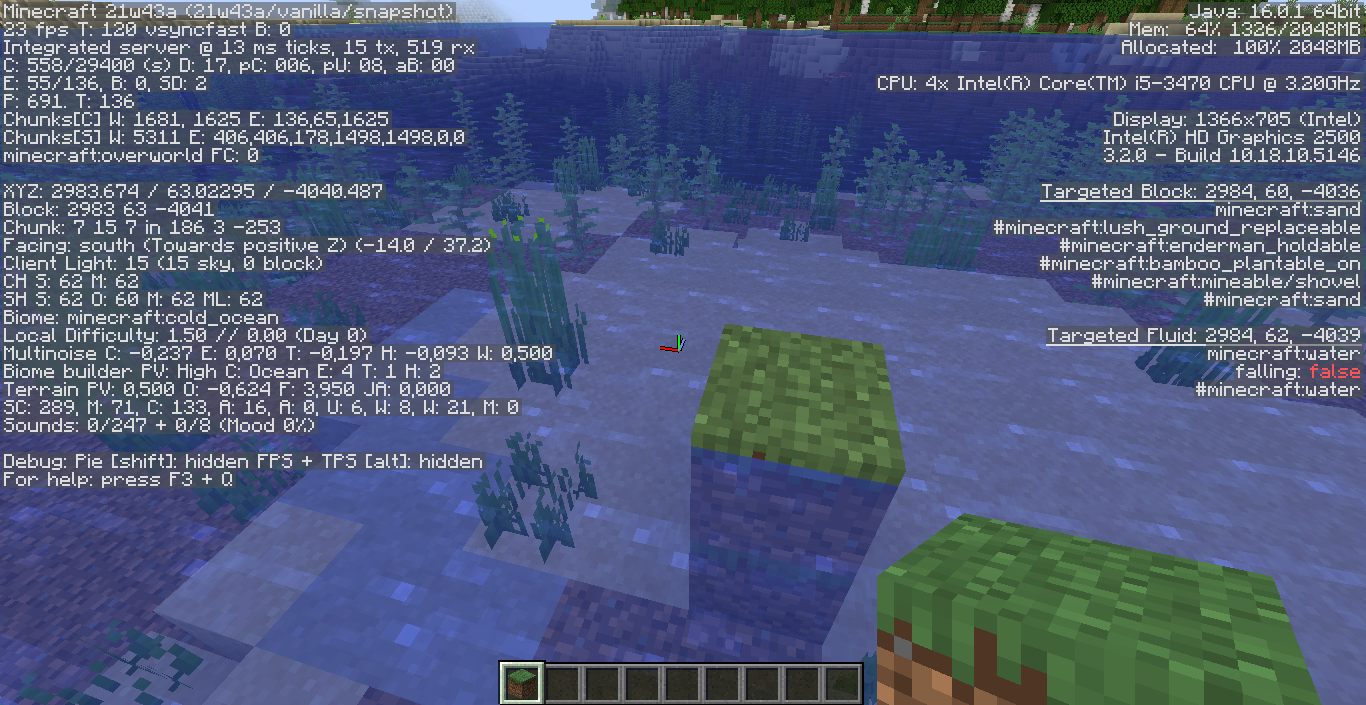
All the ocean biomes (except the normal frozen ocean) share the same internal "temperature" value (0.5) which determines the coloring of the grass, and because of that the grass color in these biomes is a gray-ish green color, which works well with the regular ocean biomes but clashes with the water colors of the other ocean biomes, it looks too cold in warm and lukewarm oceans and too warm in cold and deep frozen oceans.
That dull green grass color looks really unfitting in warm oceans, and it's even weirder that the 0.5 temperature value in that biome is the same as the coldest ocean variants, while the neighboring desert biome has a 2.0 temperature value.
The same can be said about the lukewarm ocean, it's weird seeing that dull temperate green color next to the lush and warm jungles.
Actually, that grass color fits rather well with the cold ocean, but having a temperature change in this biome would still
fit.
And lastly, while the regular frozen ocean (in the left side of the picture) has a fitting grass color and temperature value (0.0), it's deep variant still has the same temperature as the warmer oceans, which is unfitting, inconsistent and also doesn't allow for snowfall to happen in this biome, which ironically makes the deep frozen ocean not frozen, but instead full of icebergs and a purplish water to make it look frozen.
All the ocean biomes (except the normal frozen ocean) share the same internal "temperature" value (0.5) which determines the coloring of the grass, and because of that the grass color in these biomes is a gray-ish green color, which works well with the regular ocean biomes but clashes with the water colors of the other ocean biomes, it looks too cold in warm and lukewarm oceans and too warm in cold and deep frozen oceans.
That dull green grass color looks really unfitting in warm oceans, and it's even weirder that the 0.5 temperature value in that biome is the same as the coldest ocean variants, while the neighboring desert biome has a 2.0 temperature value.
The same can be said about the lukewarm ocean, it's weird seeing that dull temperate green color next to the lush and warm jungles.
Actually, that grass color fits rather well with the cold ocean, but having a temperature change in this biome to make it fit well with the taiga would still work.
And lastly, while the regular frozen ocean (in the left side of the picture) has a fitting grass color and temperature value (0.0), it's deep variant still has the same temperature as the warmer oceans, which is unfitting, inconsistent and also doesn't allow for snowfall to happen in this biome, which ironically makes the deep frozen ocean not frozen, but instead full of icebergs and a purplish water to make it look frozen.
Windows 10
All the ocean biomes (except the normal frozen ocean) share the same internal "temperature" value (0.5) which determines the coloring of the grass, and because of that the grass color in these biomes is a gray-ish green color, which works well with the regular ocean biomes but clashes with the water colors and "real" temperature of the other ocean biomes, it looks too cold in warm and lukewarm oceans and too warm in cold and deep frozen oceans.
That dull green grass color looks really unfitting in warm oceans, and it's even weirder that the 0.5 temperature value in that biome is the same as the coldest ocean variants, while the neighboring desert biome has a 2.0 temperature value.
The same can be said about the lukewarm ocean, it's weird seeing that dull temperate green color next to the lush and warm jungles.
Actually, that grass color fits rather well with the cold ocean, but having a temperature change in this biome to make it fit well with the taiga would still work.
And lastly, while the regular frozen ocean (in the left side of the picture) has a fitting grass color and temperature value (0.0), it's deep variant still has the same temperature as the warmer oceans, which is unfitting, inconsistent and also doesn't allow for snowfall to happen in this biome, which ironically makes the deep frozen ocean not frozen, but instead full of icebergs and a purplish water to make it look frozen.
All the ocean biomes (except the normal frozen ocean) share the same internal "temperature" value (0.5) which determines the coloring of the grass, and because of that the grass color in these biomes is a gray-ish green color, which works well with the regular ocean biomes but clashes with the water colors and "real" temperature of the other ocean biomes, it looks too cold in warm and lukewarm oceans and too warm in cold and deep frozen oceans. While this might seem like a minor issue as these biomes only generate in the ocean, it is still noticeable when these biomes generate on small islands or next to the shore in areas without beaches, and it often clashes with the neighboring biomes and the water colors.
That dull green grass color looks really unfitting in warm oceans, and it's even weirder that the 0.5 temperature value in that biome is the same as the coldest ocean variants, while the neighboring desert biome has a 2.0 temperature value.
The same can be said about the lukewarm ocean, it's weird seeing that dull temperate green color next to the lush and warm jungles.
Actually, that grass color fits rather well with the cold ocean, but having a temperature change in this biome to make it fit well with the taiga would still work.
And lastly, while the regular frozen ocean (in the left side of the picture) has a fitting grass color and temperature value (0.0), it's deep variant still has the same temperature as the warmer oceans, which is unfitting, inconsistent and also doesn't allow for snowfall to happen in this biome, which ironically makes the deep frozen ocean not frozen, but instead full of icebergs and a purplish water to make it look frozen.
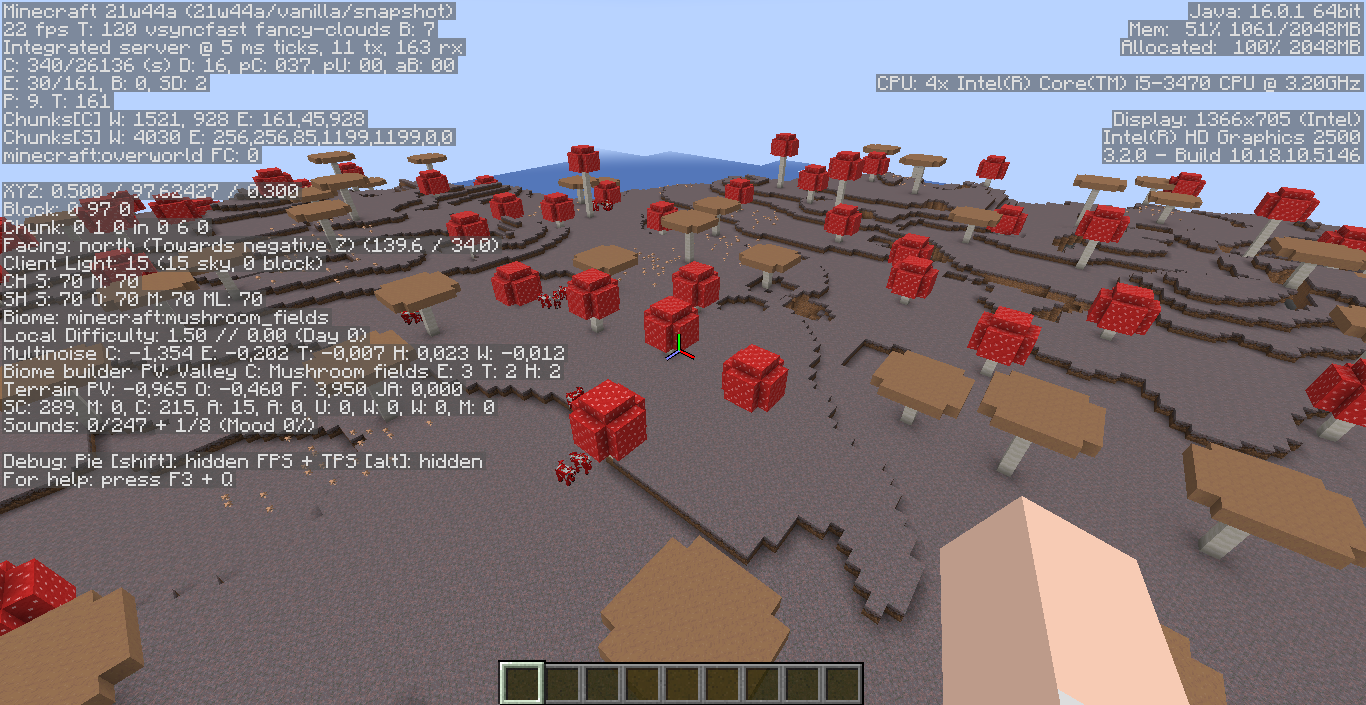
With some of the most recent snapshots, a new spawning algorithm was added to avoid players from spawning in the ocean, however, it seems like it's no longer possible to spawn in the mushroom fields biome.
In most seeds, the player spawns near the center of the map (x=0 z=0), but that can change if the center of the map is in an ocean.
SEED: -1612657249
(Zoglin)In this seed, the player spawns around x=-530 z=20, which is in a shore right next to an ocean, and by teleporting to x=0 z=0, there is a very large mushroom fields biome right at the center of the map.
/execute in minecraft:overworld run tp @s 0 ~ 0
Spawn point:
Mushroom fields at the center of the world
With some of the most recent snapshots, a new spawning algorithm was added to avoid players from spawning in the ocean, however, it seems like it's no longer possible to spawn in the mushroom fields biome.
In most seeds, the player spawns near the center of the map (x=0 z=0), but that can change if the center of the map is in an ocean.
SEED: -1612657249 / Zoglin
In this seed, the player spawns around x=-530 z=20, which is in a shore right next to an ocean, and by teleporting to x=0 z=0, there is a very large mushroom fields biome right at the center of the map.
/execute in minecraft:overworld run tp @s 0 ~ 0
Spawn point:
Mushroom fields at the center of the world
Some of the new soundtracks can play in the normal biomes when playing on survival or creative, but nothing was mentioned about these tracks playing in normal biome, instead they were intented to play only in the new biomes or the title screen.
/playsound minecraft:music.game music @a ~ ~ ~
/playsound minecraft:music.creative music @a ~ ~ ~
These are the tracks that can be heard:
- Left to Bloom
- An Ordinary Day
- Floating Dream
- Comforting Memories
Maybe a few others too but generally, you can still hear these music tracks outside the places they're intended to play.
I was looking around with the frogs and noticed that they spawn with the wrong color in some biomes:
Orange frogs spawn in taigas, old growth (pine and spruce) taigas, snowy taigas, groves, cold and frozen oceans (as well as their deep variants), snowy beaches
andfrozen rivers, but all these biomes are cold and should spawn green frogs instead.Green frogs spawn in the meadow biome, which is a temperate biome and should spawn orange frogs instead.
Green frogs spawn in stony peaks, which is a warm biome and should spawn white frogs instead.
Orange frogs spawn in lukewarm, deep lukewarm and warm oceans as well as lush caves, and these are hot biomes so they should spawn white frogs instead
I was looking around with the frogs and noticed that they spawn with the wrong color in some biomes:
Orange frogs spawn in taigas, old growth (pine and spruce) taigas, snowy taigas, groves, cold and frozen oceans (as well as their deep variants), snowy beaches, frozen rivers and windswept hills (including gravelly and forest variants), but all these biomes are cold and should spawn green frogs instead.
Green frogs spawn in the meadow biome, which is a temperate biome and should spawn orange frogs instead.
Green frogs spawn in stony peaks, which is a warm biome and should spawn white frogs instead.
Orange frogs spawn in lukewarm, deep lukewarm and warm oceans as well as lush caves, and these are hot biomes so they should spawn white frogs instead
Can confirm in 21w43a
This issue still affects 1.17.1 and 21w43a
Can confirm in 21w44a
Can confirm for 21w44a
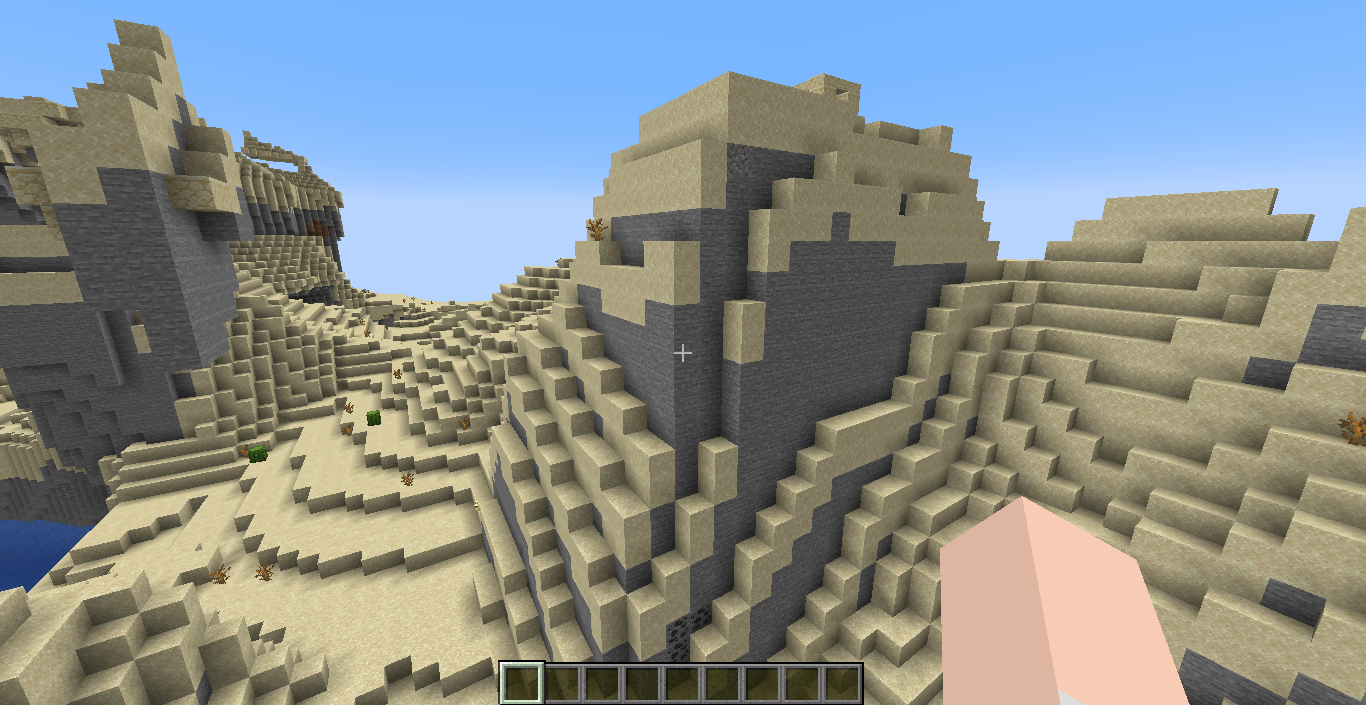
Actually, the E value stands for erosion, which controls how flat the terrain is, which means that mountainous biomes like the stony peaks generate when erosion is low, while swamps only generate when erosion is very high, so that they can always be near sea level. Also, deserts are more likely generate in areas with high erosion, and can't generate near mountains, as these get replaced by badlands instead of stony peaks.
If that's the case then the player shouldn't also be able to spawn in deserts, badlands or most other biomes except for plains and forests
Can this issue be reopened? The issue that this was duplicating was resolved as invalid for some reason.
Can confirm in 1.18 Pre-release 7. The solution for this should be simple, just change the temperature value in the biome file to 0.9 or 1.0 so it has a more vibrant and lush grass color