 MCPE-46407
Iron golem spawn distribution excludes some areas
(update 11 June 2019) Moderator: please close this. The problem I describe below turns out to be due to one of the beds being designated as the village center, which biases the spawn distribution asymmetrically. The village center is not the geometric center of the beds, it's one particular bed. I don't know if that's a bug, or if it's by design. Any enlightening comments when closing are appreciated!
I discovered this when I tried to convert a naturally-generated village to an iron farm and saw that none of the golems were spawning in my planned farm area, but rather to one side of it. I had wondered if there was something about a naturally-generated village that would bias the golem spawn distribution, so I built some experimental farms in a flat world, and they also show a bias.
Experiment 1
I built 4 simple iron golem farms using beds and villagers, surrounded by 8 sectioned-off fenced areas to get an idea of the spawn distribution. The attached picture shows an example. I have watched over 30 golems (and even more cats) spawn over the past couple of days.
Observations:
- Not one single iron golem spawned to the east of the beds, regardless of the orientation of the beds.
- Cats also never spawned to the east.
I thought sample size was large enough to conclude that there's something odd about the spawn region for both cats and iron golems. It definitely isn't an equal probability area around the beds, or around the centroid of the beds.
Here's an example simple farm, with the wood slabs in the ground marking the spots where I observed an iron golem (which I then killed). Two spawned on top of the beds; those aren't marked. East is down, west is up. The distribution pretty clearly excludes the east.
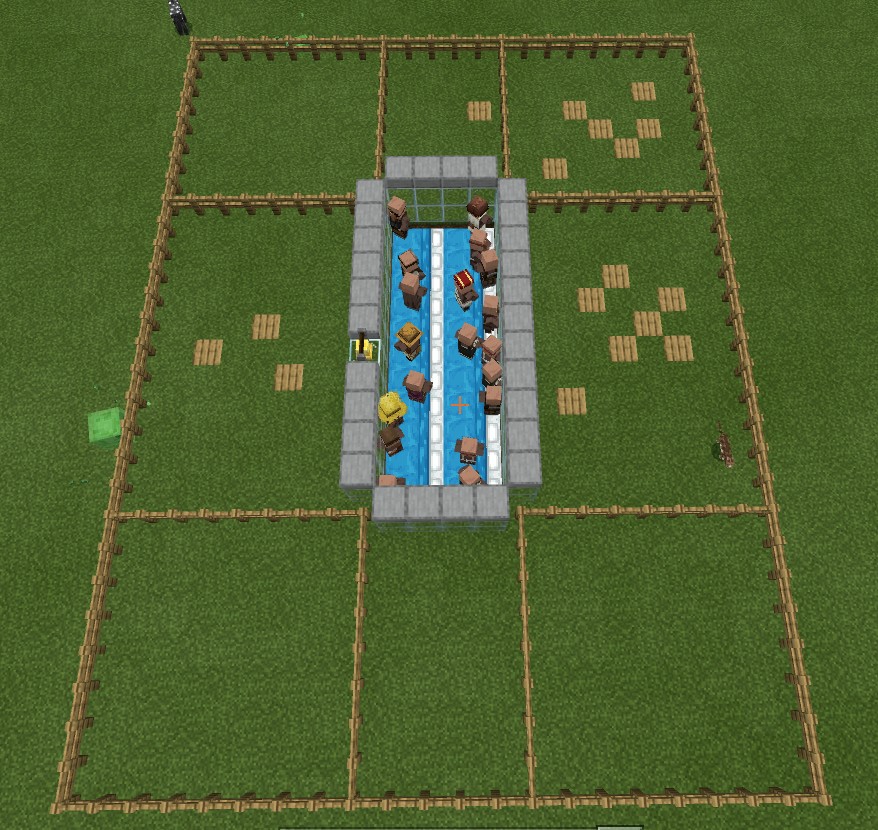
East is down in this image.
Experiment 2
That was pretty labor intensive, so I made an automated farm with two tiers of beds (12 on the bottom and 9 on top, total 21) and 10 villagers in the bottom tier, with a water trap and iron collector in each of the octants (I eventually fenced in the whole thing because some golems would sneak out along the fences):

North is up in this image.
I left it running for over 48 hours and counted up the iron ingots collected in each octant (north is up in this table):
| 23 | 26 | 10 |
| 46 | beds | 9 |
|---|---|---|
| 45 | 51 | 15 |
Here we have a bit more data. While there a few ingots appeared in the northeast and southeast after about 12 hours, there's was nothing directly east for the first 24 hours running this test. About 70% of the ingots come from the west, southwest, and south.
This was still fairly labor intensive because golems often spawned inside the building (ignoring slabs) and also embedded in the ground, so I had to watch it to clear out golems that spawned in the wrong place.
Experiment 3
Observing that the farm in experiment 2 had the intersection of four chunk boundaries among the beds (the farm was built around coordinate 0,0), I built another similar farm with the beds arranged squarely in the middle of a chunk, and let it run for a full day, monitoring it closely. This time the beds were 1 block higher relative to the water trap. I still got golems spawning in the building, but no more spawned embedded in the ground.
The distribution bias was even more pronounced. Zero ingots collected to the south. Very few to the southeast and southwest. After 24 hours, the ingots were distributed like this:
| 50 | 61 | 37 |
| 66 | beds | 29 |
|---|---|---|
| 10 | 0 | 7 |
About 70% of the ingots come from the west, northwest, and north. Less than 7% come from the southern sections, with zero ingots collected due south of the beds.

Created Issue:
Iron golem spawn distribution excludes some areas
I built 4 simple experimental iron golem farms using beds and villagers, surrounded by 8 sectioned-off fenced areas to get an idea of the spawn distribution. The attached picture shows an example. I have watched over 30 golems (and even more cats) spawn over the past couple of days.
Observations:
- Not one single iron golem has spawned to the east of the beds, regardless of the orientation of the beds.
- Cats also never spawn to the east.
I believe my sample size is large enough to conclude that there's something odd about the spawn region for both cats and iron golems. It definitely isn't an equal probability area around the beds, or around the centroid of the beds.
The attached picture shows an example simple farm, with the wood slabs in the ground marking the spots where I observed an iron golem (which I then killed). Two spawned on top of the beds; those aren't marked. East is down, west is up. The distribution pretty clearly excludes the east.
I noticed this when I tried to convert a naturally-generated village to an iron farm and saw that none of the golems were spawning in my planned farm area, but rather to the north and northwest of it. I had wondered if there was something about a naturally-generated village that would bias the golem spawn distribution, so built some farms in a flat world, and they also show a bias.
Attachments1
- Unresolved
- Open
- Unconfirmed
- Windows
- Windows 10
- 1.11.1
I built 4 simple experimental iron golem farms using beds and villagers, surrounded by 8 sectioned-off fenced areas to get an idea of the spawn distribution. The attached picture shows an example. I have watched over 30 golems (and even more cats) spawn over the past couple of days.
Observations:
- Not one single iron golem has spawned to the east of the beds, regardless of the orientation of the beds.
- Cats also never spawn to the east.
I believe my sample size is large enough to conclude that there's something odd about the spawn region for both cats and iron golems. It definitely isn't an equal probability area around the beds, or around the centroid of the beds.
The attached picture shows an example simple farm, with the wood slabs in the ground marking the spots where I observed an iron golem (which I then killed). Two spawned on top of the beds; those aren't marked. East is down, west is up. The distribution pretty clearly excludes the east.I noticed this when I tried to convert a naturally-generated village to an iron farm and saw that none of the golems were spawning in my planned farm area, but rather to the north and northwest of it. I had wondered if there was something about a naturally-generated village that would bias the golem spawn distribution, so built some farms in a flat world, and they also show a bias.
I built 4 simple experimental iron golem farms using beds and villagers, surrounded by 8 sectioned-off fenced areas to get an idea of the spawn distribution. The attached picture shows an example. I have watched over 30 golems (and even more cats) spawn over the past couple of days.
Observations:
- Not one single iron golem has spawned to the east of the beds, regardless of the orientation of the beds.
- Cats also never spawn to the east.
I believe my sample size is large enough to conclude that there's something odd about the spawn region for both cats and iron golems. It definitely isn't an equal probability area around the beds, or around the centroid of the beds.
Here's an example simple farm, with the wood slabs in the ground marking the spots where I observed an iron golem (which I then killed). Two spawned on top of the beds; those aren't marked. East is down, west is up. The distribution pretty clearly excludes the east.
That was pretty labor intensive, so I made an automated farm with two tiers of beds (12 on the bottom and 9 on top, total 21) and 10 villagers in the bottom tier, with a water trap and iron collector in each of the octants.
I left it running for over 10 hours and counted up the iron ingots collected:
16 beds I noticed this when I tried to convert a naturally-generated village to an iron farm and saw that none of the golems were spawning in my planned farm area, but rather to the north and northwest of it. I had wondered if there was something about a naturally-generated village that would bias the golem spawn distribution, so built some farms in a flat world, and they also show a bias.
I
built 4 simple experimental iron golem farms using beds and villagers, surrounded by 8 sectioned-off fenced areas to get an idea of the spawn distribution. The attached picture shows an example. I have watched over 30 golems (and even more cats) spawn over the past couple of days.Observations:
- Not one single iron golem
hasspawned to the east of the beds, regardless of the orientation of the beds.- Cats also never spawn to the east.
I
believe mysample sizeis large enough to conclude that there's something odd about the spawn region for both cats and iron golems. It definitely isn't an equal probability area around the beds, or around the centroid of the beds.Here's an example simple farm, with the wood slabs in the ground marking the spots where I observed an iron golem (which I then killed). Two spawned on top of the beds; those aren't marked. East is down, west is up. The distribution pretty clearly excludes the east.
That was pretty labor intensive, so I made an automated farm with two tiers of beds (12 on the bottom and 9 on top, total 21) and 10 villagers in the bottom tier, with a water trap and iron collector in each of the octants.
I left it running for over 10 hours and counted up the iron ingots collected:
16 beds
I noticed this when I tried to convert a naturally-generated village to an iron farm and saw that none of the golems were spawning in my planned farm area, but rather to the north and northwest of it. I had wondered iftherewas something about a naturally-generated village that would bias the golem spawn distribution, sobuilt some farms in a flat world, andthey also show a bias.I when I tried to convert a naturally-generated village to an iron farm and saw that none of the golems were spawning in my planned farm area, but rather to the north and northwest of it. I had wondered if there was something about a naturally-generated village that would bias the golem spawn distribution, so built some farms in a flat world, and they also show a bias.
I built 4 simple experimental iron golem farms using beds and villagers, surrounded by 8 sectioned-off fenced areas to get an idea of the spawn distribution. The attached picture shows an example. I have watched over 30 golems (and even more cats) spawn over the past couple of days.
Observations:
- Not one single iron golem spawned to the east of the beds, regardless of the orientation of the beds.
- Cats also never spawned to the east.
I thought sample size was large enough to conclude that there's something odd about the spawn region for both cats and iron golems. It definitely isn't an equal probability area around the beds, or around the centroid of the beds.
Here's an example simple farm, with the wood slabs in the ground marking the spots where I observed an iron golem (which I then killed). Two spawned on top of the beds; those aren't marked. East is down, west is up. The distribution pretty clearly excludes the east.
That was pretty labor intensive, so I made an automated farm with two tiers of beds (12 on the bottom and 9 on top, total 21) and 10 villagers in the bottom tier, with a water trap and iron collector in each of the octants.
I left it running for over 10 hours and counted up the iron ingots collected in each octant (north is up in this table):
13 16 3 26 beds 21 7 Here we have a bit more data. While there are a few ingots in the northeast and southeast, there's nothing directly east. Nothing from the southwest corner either, which I had thought was a fluke in my first experiment but seems to be confirmed here.
I when I tried to convert a naturally-generated village to an iron farm and saw that none of the golems were spawning in my planned farm area, but rather to the north and northwest of it. I had wondered if there was something about a naturally-generated village that would bias the golem spawn distribution, so built some farms in a flat world, and they also show a bias.
I built 4 simple
experimentaliron golem farms using beds and villagers, surrounded by 8 sectioned-off fenced areas to get an idea of the spawn distribution. The attached picture shows an example. I have watched over 30 golems (and even more cats) spawn over the past couple of days.Observations:
- Not one single iron golem spawned to the east of the beds, regardless of the orientation of the beds.
- Cats also never spawned to the east.
I thought sample size was large enough to conclude that there's something odd about the spawn region for both cats and iron golems. It definitely isn't an equal probability area around the beds, or around the centroid of the beds.
Here's an example simple farm, with the wood slabs in the ground marking the spots where I observed an iron golem (which I then killed). Two spawned on top of the beds; those aren't marked. East is down, west is up. The distribution pretty clearly excludes the east.
That was pretty labor intensive, so I made an automated farm with two tiers of beds (12 on the bottom and 9 on top, total 21) and 10 villagers in the bottom tier, with a water trap and iron collector in each of the octants.
I left it running for over 10 hours and counted up the iron ingots collected in each octant (north is up in this table):
13 16 3 26 beds 21 7 Here we have a bit more data. While there are a few ingots in the northeast and southeast, there's nothing directly east. Nothing from the southwest corner either, which I had thought was a fluke in my first experiment but seems to be confirmed here.
I when I tried to convert a naturally-generated village to an iron farm and saw that none of the golems were spawning in my planned farm area, but rather to the north and northwest of it. I had wondered if there was something about a naturally-generated village that would bias the golem spawn distribution, so I built some experimental farms in a flat world, and they also show a bias.
I built 4 simple iron golem farms using beds and villagers, surrounded by 8 sectioned-off fenced areas to get an idea of the spawn distribution. The attached picture shows an example. I have watched over 30 golems (and even more cats) spawn over the past couple of days.
Observations:
- Not one single iron golem spawned to the east of the beds, regardless of the orientation of the beds.
- Cats also never spawned to the east.
I thought sample size was large enough to conclude that there's something odd about the spawn region for both cats and iron golems. It definitely isn't an equal probability area around the beds, or around the centroid of the beds.
Here's an example simple farm, with the wood slabs in the ground marking the spots where I observed an iron golem (which I then killed). Two spawned on top of the beds; those aren't marked. East is down, west is up. The distribution pretty clearly excludes the east.
That was pretty labor intensive, so I made an automated farm with two tiers of beds (12 on the bottom and 9 on top, total 21) and 10 villagers in the bottom tier, with a water trap and iron collector in each of the octants.
I left it running for over 10 hours and counted up the iron ingots collected in each octant (north is up in this table):
13 16 3 26 beds 21 7 Here we have a bit more data. While there are a few ingots in the northeast and southeast, there's nothing directly east. Nothing from the southwest corner either, which I had thought was a fluke in my first experiment but seems to be confirmed here.
I when I tried to convert a naturally-generated village to an iron farm and saw that none of the golems were spawning in my planned farm area, but rather to the north and northwest of it. I had wondered if there was something about a naturally-generated village that would bias the golem spawn distribution, so I built some experimental farms in a flat world, and they also show a bias.
I built 4 simple iron golem farms using beds and villagers, surrounded by 8 sectioned-off fenced areas to get an idea of the spawn distribution. The attached picture shows an example. I have watched over 30 golems (and even more cats) spawn over the past couple of days.
Observations:
- Not one single iron golem spawned to the east of the beds, regardless of the orientation of the beds.
- Cats also never spawned to the east.
I thought sample size was large enough to conclude that there's something odd about the spawn region for both cats and iron golems. It definitely isn't an equal probability area around the beds, or around the centroid of the beds.
Here's an example simple farm, with the wood slabs in the ground marking the spots where I observed an iron golem (which I then killed). Two spawned on top of the beds; those aren't marked. East is down, west is up. The distribution pretty clearly excludes the east.
That was pretty labor intensive, so I made an automated farm with two tiers of beds (12 on the bottom and 9 on top, total 21) and 10 villagers in the bottom tier, with a water trap and iron collector in each of the octants.
I left it running for over 1
0hours and counted up the iron ingots collected in each octant (north is up in this table):
13 163 26 beds 21 7 Here we have a bit more data. While there are a few ingots in the northeast and southeast, there's nothing directly east. Nothing from the southwest corner either, which I had thought was a fluke in my first experiment but seems to be confirmed here.
I when I tried to convert a naturally-generated village to an iron farm and saw that none of the golems were spawning in my planned farm area, but rather to the north and northwest of it. I had wondered if there was something about a naturally-generated village that would bias the golem spawn distribution, so I built some experimental farms in a flat world, and they also show a bias.
I built 4 simple iron golem farms using beds and villagers, surrounded by 8 sectioned-off fenced areas to get an idea of the spawn distribution. The attached picture shows an example. I have watched over 30 golems (and even more cats) spawn over the past couple of days.
Observations:
- Not one single iron golem spawned to the east of the beds, regardless of the orientation of the beds.
- Cats also never spawned to the east.
I thought sample size was large enough to conclude that there's something odd about the spawn region for both cats and iron golems. It definitely isn't an equal probability area around the beds, or around the centroid of the beds.
Here's an example simple farm, with the wood slabs in the ground marking the spots where I observed an iron golem (which I then killed). Two spawned on top of the beds; those aren't marked. East is down, west is up. The distribution pretty clearly excludes the east.
That was pretty labor intensive, so I made an automated farm with two tiers of beds (12 on the bottom and 9 on top, total 21) and 10 villagers in the bottom tier, with a water trap and iron collector in each of the octants.
I left it running for over 15 hours and counted up the iron ingots collected in each octant (north is up in this table):
13 20 3 26 beds 21 7 Here we have a bit more data. While there are a few ingots in the northeast and southeast, there's nothing directly east. Nothing from the southwest corner either, which I had thought was a fluke in my first experiment but seems to be confirmed here.
I when I tried to convert a naturally-generated village to an iron farm and saw that none of the golems were spawning in my planned farm area, but rather to the north and northwest of it. I had wondered if there was something about a naturally-generated village that would bias the golem spawn distribution, so I built some experimental farms in a flat world, and they also show a bias.
I built 4 simple iron golem farms using beds and villagers, surrounded by 8 sectioned-off fenced areas to get an idea of the spawn distribution. The attached picture shows an example. I have watched over 30 golems (and even more cats) spawn over the past couple of days.
Observations:
- Not one single iron golem spawned to the east of the beds, regardless of the orientation of the beds.
- Cats also never spawned to the east.
I thought sample size was large enough to conclude that there's something odd about the spawn region for both cats and iron golems. It definitely isn't an equal probability area around the beds, or around the centroid of the beds.
Here's an example simple farm, with the wood slabs in the ground marking the spots where I observed an iron golem (which I then killed). Two spawned on top of the beds; those aren't marked. East is down, west is up. The distribution pretty clearly excludes the east.
That was pretty labor intensive, so I made an automated farm with two tiers of beds (12 on the bottom and 9 on top, total 21) and 10 villagers in the bottom tier, with a water trap and iron collector in each of the octants.
I left it running for over 15 hours and counted up the iron ingots collected in each octant (north is up in this table):
1 320 3 26beds 217Here we have a bit more data. While there are a few ingots in the northeast and southeast, there's nothing directly east.
Nothing from the southwest corner either, which I had thought was a fluke in my first experiment but seems to be confirmed here.I when I tried to convert a naturally-generated village to an iron farm and saw that none of the golems were spawning in my planned farm area, but rather to the north and northwest of it. I had wondered if there was something about a naturally-generated village that would bias the golem spawn distribution, so I built some experimental farms in a flat world, and they also show a bias.
I built 4 simple iron golem farms using beds and villagers, surrounded by 8 sectioned-off fenced areas to get an idea of the spawn distribution. The attached picture shows an example. I have watched over 30 golems (and even more cats) spawn over the past couple of days.
Observations:
- Not one single iron golem spawned to the east of the beds, regardless of the orientation of the beds.
- Cats also never spawned to the east.
I thought sample size was large enough to conclude that there's something odd about the spawn region for both cats and iron golems. It definitely isn't an equal probability area around the beds, or around the centroid of the beds.
Here's an example simple farm, with the wood slabs in the ground marking the spots where I observed an iron golem (which I then killed). Two spawned on top of the beds; those aren't marked. East is down, west is up. The distribution pretty clearly excludes the east.
That was pretty labor intensive, so I made an automated farm with two tiers of beds (12 on the bottom and 9 on top, total 21) and 10 villagers in the bottom tier, with a water trap and iron collector in each of the octants.
I left it running for over 15 hours and counted up the iron ingots collected in each octant (north is up in this table):
18 20 3 36 beds 27 34 11 Here we have a bit more data. While there are a few ingots in the northeast and southeast, there's nothing directly east.
I when I tried to convert a naturally-generated village to an iron farm and saw that none of the golems were spawning in my planned farm area, but rather to the north and northwest of it. I had wondered if there was something about a naturally-generated village that would bias the golem spawn distribution, so I built some experimental farms in a flat world, and they also show a bias.
I built 4 simple iron golem farms using beds and villagers, surrounded by 8 sectioned-off fenced areas to get an idea of the spawn distribution. The attached picture shows an example. I have watched over 30 golems (and even more cats) spawn over the past couple of days.
Observations:
- Not one single iron golem spawned to the east of the beds, regardless of the orientation of the beds.
- Cats also never spawned to the east.
I thought sample size was large enough to conclude that there's something odd about the spawn region for both cats and iron golems. It definitely isn't an equal probability area around the beds, or around the centroid of the beds.
Here's an example simple farm, with the wood slabs in the ground marking the spots where I observed an iron golem (which I then killed). Two spawned on top of the beds; those aren't marked. East is down, west is up. The distribution pretty clearly excludes the east.
That was pretty labor intensive, so I made an automated farm with two tiers of beds (12 on the bottom and 9 on top, total 21) and 10 villagers in the bottom tier, with a water trap and iron collector in each of the octants.
I left it running for over
15hours and counted up the iron ingots collected in each octant (north is up in this table):
18 2 03 36beds 273411 Here we have a bit more data. While there
area few ingots in the northeast and southeast, there's nothing directly east.I when I tried to convert a naturally-generated village to an iron farm and saw that none of the golems were spawning in my planned farm area, but rather to the north and northwest of it. I had wondered if there was something about a naturally-generated village that would bias the golem spawn distribution, so I built some experimental farms in a flat world, and they also show a bias.
I built 4 simple iron golem farms using beds and villagers, surrounded by 8 sectioned-off fenced areas to get an idea of the spawn distribution. The attached picture shows an example. I have watched over 30 golems (and even more cats) spawn over the past couple of days.
Observations:
- Not one single iron golem spawned to the east of the beds, regardless of the orientation of the beds.
- Cats also never spawned to the east.
I thought sample size was large enough to conclude that there's something odd about the spawn region for both cats and iron golems. It definitely isn't an equal probability area around the beds, or around the centroid of the beds.
Here's an example simple farm, with the wood slabs in the ground marking the spots where I observed an iron golem (which I then killed). Two spawned on top of the beds; those aren't marked. East is down, west is up. The distribution pretty clearly excludes the east.
That was pretty labor intensive, so I made an automated farm with two tiers of beds (12 on the bottom and 9 on top, total 21) and 10 villagers in the bottom tier, with a water trap and iron collector in each of the octants.
I left it running for over 32 hours and counted up the iron ingots collected in each octant (north is up in this table):
18 23 3 41 beds 5 41 51 11 Here we have a bit more data. While there a few ingots appeared in the northeast and southeast after about 12 hours, there's was nothing directly east for the first 24 hours running this test.
I when I tried to convert a naturally-generated village to an iron farm and saw that none of the golems were spawning in my planned farm area, but rather to the north and northwest of it. I had wondered if there was something about a naturally-generated village that would bias the golem spawn distribution, so I built some experimental farms in a flat world, and they also show a bias.
I built 4 simple iron golem farms using beds and villagers, surrounded by 8 sectioned-off fenced areas to get an idea of the spawn distribution. The attached picture shows an example. I have watched over 30 golems (and even more cats) spawn over the past couple of days.
Observations:
- Not one single iron golem spawned to the east of the beds, regardless of the orientation of the beds.
- Cats also never spawned to the east.
I thought sample size was large enough to conclude that there's something odd about the spawn region for both cats and iron golems. It definitely isn't an equal probability area around the beds, or around the centroid of the beds.
Here's an example simple farm, with the wood slabs in the ground marking the spots where I observed an iron golem (which I then killed). Two spawned on top of the beds; those aren't marked. East is down, west is up. The distribution pretty clearly excludes the east.
That was pretty labor intensive, so I made an automated farm with two tiers of beds (12 on the bottom and 9 on top, total 21) and 10 villagers in the bottom tier, with a water trap and iron collector in each of the octants.
I left it running for over 32 hours and counted up the iron ingots collected in each octant (north is up in this table):
18 2 3341 beds 541 51 1 1Here we have a bit more data. While there a few ingots appeared in the northeast and southeast after about 12 hours, there's was nothing directly east for the first 24 hours running this test.
I when I tried to convert a naturally-generated village to an iron farm and saw that none of the golems were spawning in my planned farm area, but rather to the north and northwest of it. I had wondered if there was something about a naturally-generated village that would bias the golem spawn distribution, so I built some experimental farms in a flat world, and they also show a bias.
I built 4 simple iron golem farms using beds and villagers, surrounded by 8 sectioned-off fenced areas to get an idea of the spawn distribution. The attached picture shows an example. I have watched over 30 golems (and even more cats) spawn over the past couple of days.
Observations:
- Not one single iron golem spawned to the east of the beds, regardless of the orientation of the beds.
- Cats also never spawned to the east.
I thought sample size was large enough to conclude that there's something odd about the spawn region for both cats and iron golems. It definitely isn't an equal probability area around the beds, or around the centroid of the beds.
Here's an example simple farm, with the wood slabs in the ground marking the spots where I observed an iron golem (which I then killed). Two spawned on top of the beds; those aren't marked. East is down, west is up. The distribution pretty clearly excludes the east.
That was pretty labor intensive, so I made an automated farm with two tiers of beds (12 on the bottom and 9 on top, total 21) and 10 villagers in the bottom tier, with a water trap and iron collector in each of the octants.
I left it running for over 32 hours and counted up the iron ingots collected in each octant (north is up in this table):
18 26 10 41 beds 9 41 51 15 Here we have a bit more data. While there a few ingots appeared in the northeast and southeast after about 12 hours, there's was nothing directly east for the first 24 hours running this test.
I when I tried to convert a naturally-generated village to an iron farm and saw that none of the golems were spawning in my planned farm area, but rather to the north and northwest of it. I had wondered if there was something about a naturally-generated village that would bias the golem spawn distribution, so I built some experimental farms in a flat world, and they also show a bias.
I built 4 simple iron golem farms using beds and villagers, surrounded by 8 sectioned-off fenced areas to get an idea of the spawn distribution. The attached picture shows an example. I have watched over 30 golems (and even more cats) spawn over the past couple of days.
Observations:
- Not one single iron golem spawned to the east of the beds, regardless of the orientation of the beds.
- Cats also never spawned to the east.
I thought sample size was large enough to conclude that there's something odd about the spawn region for both cats and iron golems. It definitely isn't an equal probability area around the beds, or around the centroid of the beds.
Here's an example simple farm, with the wood slabs in the ground marking the spots where I observed an iron golem (which I then killed). Two spawned on top of the beds; those aren't marked. East is down, west is up. The distribution pretty clearly excludes the east.
That was pretty labor intensive, so I made an automated farm with two tiers of beds (12 on the bottom and 9 on top, total 21) and 10 villagers in the bottom tier, with a water trap and iron collector in each of the octants.
I left it running for over
32hours and counted up the iron ingots collected in each octant (north is up in this table):
1826 10 4 1beds 9 4 151 15 Here we have a bit more data. While there a few ingots appeared in the northeast and southeast after about 12 hours, there's was nothing directly east for the first 24 hours running this test.
I when I tried to convert a naturally-generated village to an iron farm and saw that none of the golems were spawning in my planned farm area, but rather to the north and northwest of it. I had wondered if there was something about a naturally-generated village that would bias the golem spawn distribution, so I built some experimental farms in a flat world, and they also show a bias.
I built 4 simple iron golem farms using beds and villagers, surrounded by 8 sectioned-off fenced areas to get an idea of the spawn distribution. The attached picture shows an example. I have watched over 30 golems (and even more cats) spawn over the past couple of days.
Observations:
- Not one single iron golem spawned to the east of the beds, regardless of the orientation of the beds.
- Cats also never spawned to the east.
I thought sample size was large enough to conclude that there's something odd about the spawn region for both cats and iron golems. It definitely isn't an equal probability area around the beds, or around the centroid of the beds.
Here's an example simple farm, with the wood slabs in the ground marking the spots where I observed an iron golem (which I then killed). Two spawned on top of the beds; those aren't marked. East is down, west is up. The distribution pretty clearly excludes the east.
That was pretty labor intensive, so I made an automated farm with two tiers of beds (12 on the bottom and 9 on top, total 21) and 10 villagers in the bottom tier, with a water trap and iron collector in each of the octants.
I left it running for over 48 hours and counted up the iron ingots collected in each octant (north is up in this table):
23 26 10 46 beds 9 45 51 15 Here we have a bit more data. While there a few ingots appeared in the northeast and southeast after about 12 hours, there's was nothing directly east for the first 24 hours running this test.
I when I tried to convert a naturally-generated village to an iron farm and saw that none of the golems were spawning in my planned farm area, but rather to
the north and northwestof it. I had wondered if there was something about a naturally-generated village that would bias the golem spawn distribution, so I built some experimental farms in a flat world, and they also show a bias.I built 4 simple iron golem farms using beds and villagers, surrounded by 8 sectioned-off fenced areas to get an idea of the spawn distribution. The attached picture shows an example. I have watched over 30 golems (and even more cats) spawn over the past couple of days.
Observations:
- Not one single iron golem spawned to the east of the beds, regardless of the orientation of the beds.
- Cats also never spawned to the east.
I thought sample size was large enough to conclude that there's something odd about the spawn region for both cats and iron golems. It definitely isn't an equal probability area around the beds, or around the centroid of the beds.
Here's an example simple farm, with the wood slabs in the ground marking the spots where I observed an iron golem (which I then killed). Two spawned on top of the beds; those aren't marked. East is down, west is up. The distribution pretty clearly excludes the east.
That was pretty labor intensive, so I made an automated farm with two tiers of beds (12 on the bottom and 9 on top, total 21) and 10 villagers in the bottom tier, with a water trap and iron collector in each of the octants.
I left it running for over 48 hours and counted up the iron ingots collected in each octant (north is up in this table):
23261046beds9455115Here we have a bit more data. While there a few ingots appeared in the northeast and southeast after about 12 hours, there's was nothing directly east for the first 24 hours running this test.
I discovered this when I tried to convert a naturally-generated village to an iron farm and saw that none of the golems were spawning in my planned farm area, but rather to one side of it. I had wondered if there was something about a naturally-generated village that would bias the golem spawn distribution, so I built some experimental farms in a flat world, and they also show a bias.
I built 4 simple iron golem farms using beds and villagers, surrounded by 8 sectioned-off fenced areas to get an idea of the spawn distribution. The attached picture shows an example. I have watched over 30 golems (and even more cats) spawn over the past couple of days.
Observations:
- Not one single iron golem spawned to the east of the beds, regardless of the orientation of the beds.
- Cats also never spawned to the east.
I thought sample size was large enough to conclude that there's something odd about the spawn region for both cats and iron golems. It definitely isn't an equal probability area around the beds, or around the centroid of the beds.
Here's an example simple farm, with the wood slabs in the ground marking the spots where I observed an iron golem (which I then killed). Two spawned on top of the beds; those aren't marked. East is down, west is up. The distribution pretty clearly excludes the east.
That was pretty labor intensive, so I made an automated farm with two tiers of beds (12 on the bottom and 9 on top, total 21) and 10 villagers in the bottom tier, with a water trap and iron collector in each of the octants.
I left it running for over 48 hours and counted up the iron ingots collected in each octant (north is up in this table):
23 26 10 46 beds 9 45 51 15 Here we have a bit more data. While there a few ingots appeared in the northeast and southeast after about 12 hours, there's was nothing directly east for the first 24 hours running this test. About 70% of the ingots come from the west, southwest, and south.
I discovered this when I tried to convert a naturally-generated village to an iron farm and saw that none of the golems were spawning in my planned farm area, but rather to one side of it. I had wondered if there was something about a naturally-generated village that would bias the golem spawn distribution, so I built some experimental farms in a flat world, and they also show a bias.
I built 4 simple iron golem farms using beds and villagers, surrounded by 8 sectioned-off fenced areas to get an idea of the spawn distribution. The attached picture shows an example. I have watched over 30 golems (and even more cats) spawn over the past couple of days.
Observations:
- Not one single iron golem spawned to the east of the beds, regardless of the orientation of the beds.
- Cats also never spawned to the east.
I thought sample size was large enough to conclude that there's something odd about the spawn region for both cats and iron golems. It definitely isn't an equal probability area around the beds, or around the centroid of the beds.
Here's an example simple farm, with the wood slabs in the ground marking the spots where I observed an iron golem (which I then killed). Two spawned on top of the beds; those aren't marked. East is down, west is up. The distribution pretty clearly excludes the east.
That was pretty labor intensive, so I made an automated farm with two tiers of beds (12 on the bottom and 9 on top, total 21) and 10 villagers in the bottom tier, with a water trap and iron collector in each of the octants
.
I left it running for over 48 hours and counted up the iron ingots collected in each octant (north is up in this table):
23 26 10 46 beds 9 45 51 15 Here we have a bit more data. While there a few ingots appeared in the northeast and southeast after about 12 hours, there's was nothing directly east for the first 24 hours running this test. About 70% of the ingots come from the west, southwest, and south.
I discovered this when I tried to convert a naturally-generated village to an iron farm and saw that none of the golems were spawning in my planned farm area, but rather to one side of it. I had wondered if there was something about a naturally-generated village that would bias the golem spawn distribution, so I built some experimental farms in a flat world, and they also show a bias.
I built 4 simple iron golem farms using beds and villagers, surrounded by 8 sectioned-off fenced areas to get an idea of the spawn distribution. The attached picture shows an example. I have watched over 30 golems (and even more cats) spawn over the past couple of days.
Observations:
- Not one single iron golem spawned to the east of the beds, regardless of the orientation of the beds.
- Cats also never spawned to the east.
I thought sample size was large enough to conclude that there's something odd about the spawn region for both cats and iron golems. It definitely isn't an equal probability area around the beds, or around the centroid of the beds.
Here's an example simple farm, with the wood slabs in the ground marking the spots where I observed an iron golem (which I then killed). Two spawned on top of the beds; those aren't marked. East is down, west is up. The distribution pretty clearly excludes the east.
That was pretty labor intensive, so I made an automated farm with two tiers of beds (12 on the bottom and 9 on top, total 21) and 10 villagers in the bottom tier, with a water trap and iron collector in each of the octants (I eventually fenced in the whole thing because some golems would sneak out along the fences):
I left it running for over 48 hours and counted up the iron ingots collected in each octant (north is up in this table):
23 26 10 46 beds 9 45 51 15 Here we have a bit more data. While there a few ingots appeared in the northeast and southeast after about 12 hours, there's was nothing directly east for the first 24 hours running this test. About 70% of the ingots come from the west, southwest, and south.
I discovered this when I tried to convert a naturally-generated village to an iron farm and saw that none of the golems were spawning in my planned farm area, but rather to one side of it. I had wondered if there was something about a naturally-generated village that would bias the golem spawn distribution, so I built some experimental farms in a flat world, and they also show a bias.
I built 4 simple iron golem farms using beds and villagers, surrounded by 8 sectioned-off fenced areas to get an idea of the spawn distribution. The attached picture shows an example. I have watched over 30 golems (and even more cats) spawn over the past couple of days.
Observations:
- Not one single iron golem spawned to the east of the beds, regardless of the orientation of the beds.
- Cats also never spawned to the east.
I thought sample size was large enough to conclude that there's something odd about the spawn region for both cats and iron golems. It definitely isn't an equal probability area around the beds, or around the centroid of the beds.
Here's an example simple farm, with the wood slabs in the ground marking the spots where I observed an iron golem (which I then killed). Two spawned on top of the beds; those aren't marked. East is down, west is up. The distribution pretty clearly excludes the east.
That was pretty labor intensive, so I made an automated farm with two tiers of beds (12 on the bottom and 9 on top, total 21) and 10 villagers in the bottom tier, with a water trap and iron collector in each of the octants (I eventually fenced in the whole thing because some golems would sneak out along the fences):
I left it running for over 48 hours and countedup the ironingots collectedin each octant (north is up in this table):
23261046beds 9 455115
Here we have a bit more data. While there a few ingots appeared in thenortheast andsoutheast after about 12 hours, there's was nothing directly east for the first 24 hours running this test. About 70% of the ingots come from the west, southwest, and south.I discovered this when I tried to convert a naturally-generated village to an iron farm and saw that none of the golems were spawning in my planned farm area, but rather to one side of it. I had wondered if there was something about a naturally-generated village that would bias the golem spawn distribution, so I built some experimental farms in a flat world, and they also show a bias.
Experiment 1
I built 4 simple iron golem farms using beds and villagers, surrounded by 8 sectioned-off fenced areas to get an idea of the spawn distribution. The attached picture shows an example. I have watched over 30 golems (and even more cats) spawn over the past couple of days.
Observations:
- Not one single iron golem spawned to the east of the beds, regardless of the orientation of the beds.
- Cats also never spawned to the east.
I thought sample size was large enough to conclude that there's something odd about the spawn region for both cats and iron golems. It definitely isn't an equal probability area around the beds, or around the centroid of the beds.
Here's an example simple farm, with the wood slabs in the ground marking the spots where I observed an iron golem (which I then killed). Two spawned on top of the beds; those aren't marked. East is down, west is up. The distribution pretty clearly excludes the east.
Experiment 2
That was pretty labor intensive, so I made an automated farm with two tiers of beds (12 on the bottom and 9 on top, total 21) and 10 villagers in the bottom tier, with a water trap and iron collector in each of the octants (I eventually fenced in the whole thing because some golems would sneak out along the fences):
I left it running for over 48 hours and counted up the iron ingots collected in each octant (north is up in this table):
23 26 10 46 beds 9 45 51 15 Here we have a bit more data. While there a few ingots appeared in the northeast and southeast after about 12 hours, there's was nothing directly east for the first 24 hours running this test. About 70% of the ingots come from the west, southwest, and south.
This was still fairly labor intensive because golems often spawned inside the building (ignoring slabs) and also embedded in the ground, so I had to watch it to clear out the golem that spawned in the wrong place.
Experiment 3
Observing that the farm in experiment 2 had the intersection of four chunk boundaries among the beds (the farm was built around coordinate 0,0), I built another similar farm with the beds arranged squarely in the middle of a chunk, and let it run for a full day, monitoring it closely. This time the beds were 1 block higher relative to the water trap. I still got golems spawning in the building, but no more spawned embedded in the ground.
The distribution bias was even more pronounced. Zero ingots collected to the south. Very few to the southeast and southwest. After 24 hours, the ingots were distributed like this:
50 61 37 66 beds 29 10 0 7 About 70% of the ingots come from the west, northwest, and north. Less than 7% come from the southern sections, with zero ingots collected due south of the beds.
I discovered this when I tried to convert a naturally-generated village to an iron farm and saw that none of the golems were spawning in my planned farm area, but rather to one side of it. I had wondered if there was something about a naturally-generated village that would bias the golem spawn distribution, so I built some experimental farms in a flat world, and they also show a bias.
Experiment 1
I built 4 simple iron golem farms using beds and villagers, surrounded by 8 sectioned-off fenced areas to get an idea of the spawn distribution. The attached picture shows an example. I have watched over 30 golems (and even more cats) spawn over the past couple of days.
Observations:
- Not one single iron golem spawned to the east of the beds, regardless of the orientation of the beds.
- Cats also never spawned to the east.
I thought sample size was large enough to conclude that there's something odd about the spawn region for both cats and iron golems. It definitely isn't an equal probability area around the beds, or around the centroid of the beds.
Here's an example simple farm, with the wood slabs in the ground marking the spots where I observed an iron golem (which I then killed). Two spawned on top of the beds; those aren't marked. East is down, west is up. The distribution pretty clearly excludes the east.
East is down in this image.Experiment 2
That was pretty labor intensive, so I made an automated farm with two tiers of beds (12 on the bottom and 9 on top, total 21) and 10 villagers in the bottom tier, with a water trap and iron collector in each of the octants (I eventually fenced in the whole thing because some golems would sneak out along the fences):
North is up in this image.I left it running for over 48 hours and counted up the iron ingots collected in each octant (north is up in this table):
23 26 10 46 beds 9 45 51 15 Here we have a bit more data. While there a few ingots appeared in the northeast and southeast after about 12 hours, there's was nothing directly east for the first 24 hours running this test. About 70% of the ingots come from the west, southwest, and south.
This was still fairly labor intensive because golems often spawned inside the building (ignoring slabs) and also embedded in the ground, so I had to watch it to clear out the golem that spawned in the wrong place.
Experiment 3
Observing that the farm in experiment 2 had the intersection of four chunk boundaries among the beds (the farm was built around coordinate 0,0), I built another similar farm with the beds arranged squarely in the middle of a chunk, and let it run for a full day, monitoring it closely. This time the beds were 1 block higher relative to the water trap. I still got golems spawning in the building, but no more spawned embedded in the ground.
The distribution bias was even more pronounced. Zero ingots collected to the south. Very few to the southeast and southwest. After 24 hours, the ingots were distributed like this:
50 61 37 66 beds 29 10 0 7 About 70% of the ingots come from the west, northwest, and north. Less than 7% come from the southern sections, with zero ingots collected due south of the beds.
I discovered this when I tried to convert a naturally-generated village to an iron farm and saw that none of the golems were spawning in my planned farm area, but rather to one side of it. I had wondered if there was something about a naturally-generated village that would bias the golem spawn distribution, so I built some experimental farms in a flat world, and they also show a bias.
Experiment 1
I built 4 simple iron golem farms using beds and villagers, surrounded by 8 sectioned-off fenced areas to get an idea of the spawn distribution. The attached picture shows an example. I have watched over 30 golems (and even more cats) spawn over the past couple of days.
Observations:
- Not one single iron golem spawned to the east of the beds, regardless of the orientation of the beds.
- Cats also never spawned to the east.
I thought sample size was large enough to conclude that there's something odd about the spawn region for both cats and iron golems. It definitely isn't an equal probability area around the beds, or around the centroid of the beds.
Here's an example simple farm, with the wood slabs in the ground marking the spots where I observed an iron golem (which I then killed). Two spawned on top of the beds; those aren't marked. East is down, west is up. The distribution pretty clearly excludes the east.
East is down in this image.Experiment 2
That was pretty labor intensive, so I made an automated farm with two tiers of beds (12 on the bottom and 9 on top, total 21) and 10 villagers in the bottom tier, with a water trap and iron collector in each of the octants (I eventually fenced in the whole thing because some golems would sneak out along the fences):
North is up in this image.I left it running for over 48 hours and counted up the iron ingots collected in each octant (north is up in this table):
23 26 10 46 beds 9 45 51 15 Here we have a bit more data. While there a few ingots appeared in the northeast and southeast after about 12 hours, there's was nothing directly east for the first 24 hours running this test. About 70% of the ingots come from the west, southwest, and south.
This was still fairly labor intensive because golems often spawned inside the building (ignoring slabs) and also embedded in the ground, so I had to watch it to clear out
thegolem that spawned in the wrong place.Experiment 3
Observing that the farm in experiment 2 had the intersection of four chunk boundaries among the beds (the farm was built around coordinate 0,0), I built another similar farm with the beds arranged squarely in the middle of a chunk, and let it run for a full day, monitoring it closely. This time the beds were 1 block higher relative to the water trap. I still got golems spawning in the building, but no more spawned embedded in the ground.
The distribution bias was even more pronounced. Zero ingots collected to the south. Very few to the southeast and southwest. After 24 hours, the ingots were distributed like this:
50 61 37 66 beds 29 10 0 7 About 70% of the ingots come from the west, northwest, and north. Less than 7% come from the southern sections, with zero ingots collected due south of the beds.
I discovered this when I tried to convert a naturally-generated village to an iron farm and saw that none of the golems were spawning in my planned farm area, but rather to one side of it. I had wondered if there was something about a naturally-generated village that would bias the golem spawn distribution, so I built some experimental farms in a flat world, and they also show a bias.
Experiment 1
I built 4 simple iron golem farms using beds and villagers, surrounded by 8 sectioned-off fenced areas to get an idea of the spawn distribution. The attached picture shows an example. I have watched over 30 golems (and even more cats) spawn over the past couple of days.
Observations:
- Not one single iron golem spawned to the east of the beds, regardless of the orientation of the beds.
- Cats also never spawned to the east.
I thought sample size was large enough to conclude that there's something odd about the spawn region for both cats and iron golems. It definitely isn't an equal probability area around the beds, or around the centroid of the beds.
Here's an example simple farm, with the wood slabs in the ground marking the spots where I observed an iron golem (which I then killed). Two spawned on top of the beds; those aren't marked. East is down, west is up. The distribution pretty clearly excludes the east.
East is down in this image.Experiment 2
That was pretty labor intensive, so I made an automated farm with two tiers of beds (12 on the bottom and 9 on top, total 21) and 10 villagers in the bottom tier, with a water trap and iron collector in each of the octants (I eventually fenced in the whole thing because some golems would sneak out along the fences):
North is up in this image.I left it running for over 48 hours and counted up the iron ingots collected in each octant (north is up in this table):
23 26 10 46 beds 9 45 51 15 Here we have a bit more data. While there a few ingots appeared in the northeast and southeast after about 12 hours, there's was nothing directly east for the first 24 hours running this test. About 70% of the ingots come from the west, southwest, and south.
This was still fairly labor intensive because golems often spawned inside the building (ignoring slabs) and also embedded in the ground, so I had to watch it to clear out golems that spawned in the wrong place.
Experiment 3
Observing that the farm in experiment 2 had the intersection of four chunk boundaries among the beds (the farm was built around coordinate 0,0), I built another similar farm with the beds arranged squarely in the middle of a chunk, and let it run for a full day, monitoring it closely. This time the beds were 1 block higher relative to the water trap. I still got golems spawning in the building, but no more spawned embedded in the ground.
The distribution bias was even more pronounced. Zero ingots collected to the south. Very few to the southeast and southwest. After 24 hours, the ingots were distributed like this:
50 61 37 66 beds 29 10 0 7 About 70% of the ingots come from the west, northwest, and north. Less than 7% come from the southern sections, with zero ingots collected due south of the beds.
I'm wondering now if the nonuniform distribution might be due to chunk boundaries dividing up the building with the beds.
I discovered this when I tried to convert a naturally-generated village to an iron farm and saw that none of the golems were spawning in my planned farm area, but rather to one side of it. I had wondered if there was something about a naturally-generated village that would bias the golem spawn distribution, so I built some experimental farms in a flat world, and they also show a bias.
Experiment 1
I built 4 simple iron golem farms using beds and villagers, surrounded by 8 sectioned-off fenced areas to get an idea of the spawn distribution. The attached picture shows an example. I have watched over 30 golems (and even more cats) spawn over the past couple of days.
Observations:
- Not one single iron golem spawned to the east of the beds, regardless of the orientation of the beds.
- Cats also never spawned to the east.
I thought sample size was large enough to conclude that there's something odd about the spawn region for both cats and iron golems. It definitely isn't an equal probability area around the beds, or around the centroid of the beds.
Here's an example simple farm, with the wood slabs in the ground marking the spots where I observed an iron golem (which I then killed). Two spawned on top of the beds; those aren't marked. East is down, west is up. The distribution pretty clearly excludes the east.
East is down in this image.Experiment 2
That was pretty labor intensive, so I made an automated farm with two tiers of beds (12 on the bottom and 9 on top, total 21) and 10 villagers in the bottom tier, with a water trap and iron collector in each of the octants (I eventually fenced in the whole thing because some golems would sneak out along the fences):
North is up in this image.I left it running for over 48 hours and counted up the iron ingots collected in each octant (north is up in this table):
23 26 10 46 beds 9 45 51 15 Here we have a bit more data. While there a few ingots appeared in the northeast and southeast after about 12 hours, there's was nothing directly east for the first 24 hours running this test. About 70% of the ingots come from the west, southwest, and south.
This was still fairly labor intensive because golems often spawned inside the building (ignoring slabs) and also embedded in the ground, so I had to watch it to clear out golems that spawned in the wrong place.
Experiment 3
Observing that the farm in experiment 2 had the intersection of four chunk boundaries among the beds (the farm was built around coordinate 0,0), I built another similar farm with the beds arranged squarely in the middle of a chunk, and let it run for a full day, monitoring it closely. This time the beds were 1 block higher relative to the water trap. I still got golems spawning in the building, but no more spawned embedded in the ground.
The distribution bias was even more pronounced. Zero ingots collected to the south. Very few to the southeast and southwest. After 24 hours, the ingots were distributed like this:
50 61 37 66 beds 29 10 0 7 About 70% of the ingots come from the west, northwest, and north. Less than 7% come from the southern sections, with zero ingots collected due south of the beds.
(update 11 June 2019) Moderator: please close this. The problem I describe below turns out to be due to one of the beds being designated as the village center, which biases the spawn distribution asymmetrically. The village center is not the geometric center of the beds, it's one particular bed. I don't know if that's a bug, or if it's by design. Any enlightening comments when closing are appreciated!
Original descriptionI discovered this when I tried to convert a naturally-generated village to an iron farm and saw that none of the golems were spawning in my planned farm area, but rather to one side of it. I had wondered if there was something about a naturally-generated village that would bias the golem spawn distribution, so I built some experimental farms in a flat world, and they also show a bias.
Experiment 1
I built 4 simple iron golem farms using beds and villagers, surrounded by 8 sectioned-off fenced areas to get an idea of the spawn distribution. The attached picture shows an example. I have watched over 30 golems (and even more cats) spawn over the past couple of days.
Observations:
- Not one single iron golem spawned to the east of the beds, regardless of the orientation of the beds.
- Cats also never spawned to the east.
I thought sample size was large enough to conclude that there's something odd about the spawn region for both cats and iron golems. It definitely isn't an equal probability area around the beds, or around the centroid of the beds.
Here's an example simple farm, with the wood slabs in the ground marking the spots where I observed an iron golem (which I then killed). Two spawned on top of the beds; those aren't marked. East is down, west is up. The distribution pretty clearly excludes the east.
East is down in this image.Experiment 2
That was pretty labor intensive, so I made an automated farm with two tiers of beds (12 on the bottom and 9 on top, total 21) and 10 villagers in the bottom tier, with a water trap and iron collector in each of the octants (I eventually fenced in the whole thing because some golems would sneak out along the fences):
North is up in this image.I left it running for over 48 hours and counted up the iron ingots collected in each octant (north is up in this table):
23 26 10 46 beds 9 45 51 15 Here we have a bit more data. While there a few ingots appeared in the northeast and southeast after about 12 hours, there's was nothing directly east for the first 24 hours running this test. About 70% of the ingots come from the west, southwest, and south.
This was still fairly labor intensive because golems often spawned inside the building (ignoring slabs) and also embedded in the ground, so I had to watch it to clear out golems that spawned in the wrong place.
Experiment 3
Observing that the farm in experiment 2 had the intersection of four chunk boundaries among the beds (the farm was built around coordinate 0,0), I built another similar farm with the beds arranged squarely in the middle of a chunk, and let it run for a full day, monitoring it closely. This time the beds were 1 block higher relative to the water trap. I still got golems spawning in the building, but no more spawned embedded in the ground.
The distribution bias was even more pronounced. Zero ingots collected to the south. Very few to the southeast and southwest. After 24 hours, the ingots were distributed like this:
50 61 37 66 beds 29 10 0 7 About 70% of the ingots come from the west, northwest, and north. Less than 7% come from the southern sections, with zero ingots collected due south of the beds.
![[Mojang] Mega_Spud (Jay Wells)](../../../data/avatars/users/92696.png)
And here's another one. In this picture, the golem spawned in a house that was deliberately built with an oak slab floor and ceiling, with 2 blocks of vertical air space. The golem spawned with its feet inside the bed, standing on a slab. This violates 2 previous rules: that an iron golem needs a vertical space of 3 transparent blocks, and that iron golems don't spawn on slabs. These were top slabs, though, but I thought golems don't spawn on any slab.

In this same house I've also seen them spawn buried in the ground like the other pictures, but with the head and shoulders sticking out of a slab. See my related ticket MCPE-46407.
Experimentally I tried removing the underground blocks on which the golems were spawning, hollowing out a space 3 blocks deep. After that, no iron golems spawned at all (I left the game running all night).
After several days of this, I have to say that iron golem spawning in Bedrock 1.11 is definitely buggy, making an iron farm a fiddly finicky thing that needs regular attention and maintenance due to spawning errors.
In observing this farm, I've seen iron golems spawning
MCPE-41886– in this case in the ground with its head and shoulders sticking out of a slab (happened 4 times). Experimentally I hollowed out the volume underground to remove the underground blocks the golems were spawning on, and after that, no iron golems spawned at all, anywhere.