 A. Matulich
- anachronist
- anachronist
- America/Los_Angeles
- Yes
- No
 MCPE-30428
 MC-264834



This is likely unrelated to invisible chunks caused by slow generation as reported in
MCPE-19308, which I re-reported inMCPE-30428. I'mpulling the comments for thisunrelated bug from that ticket.When digging a tunnel in close quarters, I'll sometimes encounter a block that looks invisible with empty space beyond (I see bright sky beyond even though I'm not looking up).
I don't see how slow generation would this. I'm moving slowly, at the rate of 1 block every second or so. In this case I don't see underground structure through the 'window' as described in
MCPE-30428, but I do sometimes see silhouettes of mobs in the distance. It's almost as if the game loses track of a single block.This occurred a couple days ago; I had just started a new survival game (no flying). I didn't explore, I just harvested wood from a nearby tree and immediately began digging a temporary shelter using a pickaxe from the starting bonus chest. I had dug a stairway down about 4 blocks and was digging out a small room for a crafting table and a furnace, when one of the blocks on the wall became invisible, showing bright blue sky and a distant silhouette of a skeleton bobbing up and down, likely in the river near where I spawned.
I've also seen a floor block do this (not 1.2.9 but some previous 1.2.x version). The first time that happened, seeing bright sky through a hole in the floor, I thought I had broken through the bottom of the world, which should be impossible in survival mode (and I hadn't dug anywhere deep enough either).
When it happens, it typically affects just 1 block. Digging out and replacing the invisible block fixes the problem.
This is likely unrelated to invisible chunks caused by slow generation as reported in
MCPE-19308, which I re-reported inMCPE-30428. I'm creating this description of an unrelated bug from the comments in that ticket.When digging a tunnel in close quarters, I'll sometimes encounter a block that looks invisible with empty space beyond (I see bright blue sky beyond even though I'm not looking up).
I don't see how slow generation would cause this. I'm moving slowly, at the rate of 1 block every second or so. In this case I don't see underground structure through the 'window' as described in
MCPE-30428, but I do sometimes see silhouettes of mobs in the distance. It's almost as if the game loses track of a single block.This occurred a couple days ago; I had just started a new survival game (no flying). I didn't explore, I just harvested wood from a nearby tree and immediately began digging a temporary shelter using a pickaxe from the starting bonus chest. I had dug a stairway down about 4 blocks and was digging out a small room for a crafting table and a furnace, when one of the blocks on the wall became invisible, showing bright blue sky and a distant silhouette of a skeleton bobbing up and down, likely in the river near where I spawned.
I've also seen a floor block do this (not 1.2.9 but some previous 1.2.x version). The first time that happened, seeing bright sky through a hole in the floor, I thought I had broken through the bottom of the world, which should be impossible in survival mode (and I hadn't dug anywhere deep enough either).
When it happens, it typically affects just 1 block. Digging out and replacing the invisible block fixes the problem.
This is likely unrelated to invisible chunks caused by slow generation as reported in
MCPE-19308, which I re-reported inMCPE-30428. I'm creating this description of an unrelated bug from the comments in that ticket.When digging a tunnel in close quarters, I'll sometimes encounter a block that looks invisible with empty space beyond (I see bright blue sky beyond even though I'm not looking up).
I don't see how slow generation would cause this. I'm moving slowly, at the rate of 1 block every second or so. In this case I don't see underground structure through the 'window' as described in
MCPE-30428, but I do sometimes see silhouettes of mobs in the distance. It's almost as if the game loses track of a single block.This occurred a couple days ago; I had just started a new survival game
(no flying).I didn't explore, I just harvested wood from a nearby tree and immediately began digging a temporary shelter using a pickaxe from the starting bonus chest. I had dug a stairway down about 4 blocks and was digging out a small room for a crafting table and a furnace, when one of the blocks on the wall became invisible, showing bright blue sky and a distant silhouette of a skeleton bobbing up and down, likely in the river near where I spawned.I've also seen a floor block do this (not 1.2.9 but some previous 1.2.x version). The first time that happened, seeing bright sky through a hole in the floor, I thought I had broken through the bottom of the world, which should be impossible in survival mode (and I hadn't dug anywhere deep enough either).
When it happens, it typically affects just 1 block. Digging out and replacing the invisible block fixes the problem.
This is likely unrelated to invisible chunks caused by slow generation as reported in
MCPE-19308, which I re-reported inMCPE-30428. I'm creating this description of an unrelated bug from the comments in that ticket.When digging a tunnel in close quarters, I'll sometimes encounter a block that looks invisible with empty space beyond (I see bright blue sky beyond even though I'm not looking up).
I don't see how slow generation would cause this. I'm moving slowly, at the rate of 1 block every second or so. In this case I don't see underground structure through the 'window' as described in
MCPE-30428, but I do sometimes see silhouettes of mobs in the distance. It's almost as if the game loses track of a single block.This occurred a couple days ago; I had just started a new survival game. After spawning for the first time, I didn't explore, I just harvested wood from a nearby tree and immediately began digging a temporary shelter using a pickaxe from the starting bonus chest. I had dug a stairway down about 4 blocks and was digging out a small room for a crafting table and a furnace, when one of the blocks on the wall became invisible, showing bright blue sky and a distant silhouette of a skeleton bobbing up and down, likely in the river near where I spawned.
I've also seen a floor block do this (not 1.2.9 but some previous 1.2.x version). The first time that happened, seeing bright sky through a hole in the floor, I thought I had broken through the bottom of the world, which should be impossible in survival mode (and I hadn't dug anywhere deep enough either).
When it happens, it typically affects just 1 block. Digging out and replacing the invisible block fixes the problem.
This is likely unrelated to invisible chunks caused by slow generation as reported in
MCPE-19308, which I re-reported inMCPE-30428. I'm creating this description of an unrelated bug from the comments in that ticket.When digging a tunnel in close quarters, I'll sometimes encounter a block that looks invisible with empty space beyond (I see bright blue sky beyond even though I'm not looking up).
I don't see how slow generation would cause this. I'm moving slowly, at the rate of 1 block every second or so. In this case I don't see underground structure through the 'window' as described in
MCPE-30428, but I do sometimes see silhouettes of mobs in the distance. It's almost as if the game loses track of a single block.This occurred a couple days ago; I had just started a new survival game. After spawning for the first time, I didn't explore, I just harvested wood from a nearby tree and immediately began digging a temporary shelter using a pickaxe from the starting bonus chest. I had dug a stairway down about 4 blocks and was digging out a small room for a crafting table and a furnace, when one of the blocks on the wall became invisible, showing bright blue sky and a distant silhouette of a skeleton bobbing up and down, likely in the river near where I spawned.
I've also seen a floor block do this (not 1.2.9 but some previous 1.2.x version). The first time that happened, seeing bright sky through a hole in the floor, I thought I had broken through the bottom of the world, which should be
impossible in survival mode (and I hadn't dug anywhere deep enough either).When it happens, it typically affects just 1 block. Digging out and replacing the invisible block fixes the problem.
This is likely unrelated to invisible chunks caused by slow generation as reported in
MCPE-19308, which I re-reported inMCPE-30428. I'm creating this description of an unrelated bug from the comments in that ticket.When digging a tunnel in close quarters, I'll sometimes encounter a block that looks invisible with empty space beyond (I see bright blue sky beyond even though I'm not looking up).
I don't see how slow generation would cause this. I'm moving slowly, at the rate of 1 block every second or so. In this case I don't see underground structure through the 'window' as described in
MCPE-30428, but I do sometimes see silhouettes of mobs in the distance. It's almost as if the game loses track of a single block.This occurred a couple days ago; I had just started a new survival game. After spawning for the first time, I didn't explore, I just harvested wood from a nearby tree and immediately began digging a temporary shelter using a pickaxe from the starting bonus chest. I had dug a stairway down about 4 blocks and was digging out a small room for a crafting table and a furnace, when one of the blocks on the wall became invisible, showing bright blue sky and a distant silhouette of a skeleton bobbing up and down, likely in the river near where I spawned.
I've also seen a floor block do this (not 1.2.9 but some previous 1.2.x version). The first time that happened, seeing bright sky through a hole in the floor, I thought I had broken through the bottom of the world, which shouldn't be ossible in survival mode (and I hadn't dug anywhere deep enough either).
When it happens, it typically affects just 1 block. Digging out and replacing the invisible block fixes the problem.
This is likely unrelated to invisible chunks caused by slow generation as reported in
MCPE-19308, which I re-reported inMCPE-30428. I'm creating this description of an unrelated bug from the comments in that ticket.When digging a tunnel in close quarters, I'll sometimes encounter a block that looks invisible with empty space beyond (I see bright blue sky beyond even though I'm not looking up).
I don't see how slow generation would cause this. I'm moving slowly, at the rate of 1 block every second or so. In this case I don't see underground structure through the 'window' as described in
MCPE-30428, but I do sometimes see silhouettes of mobs in the distance. It's almost as if the game loses track of a single block.This occurred a couple days ago; I had just started a new survival game. After spawning for the first time, I didn't explore, I just harvested wood from a nearby tree and immediately began digging a temporary shelter using a pickaxe from the starting bonus chest. I had dug a stairway down about 4 blocks and was digging out a small room for a crafting table and a furnace, when one of the blocks on the wall became invisible, showing bright blue sky and a distant silhouette of a skeleton bobbing up and down, likely in the river near where I spawned.
I've also seen a floor block do this (not 1.2.9 but some previous 1.2.x version). The first time that happened, seeing bright sky through a hole in the floor, I thought I had broken through the bottom of the world, which shouldn't be possible in survival mode (and I hadn't dug anywhere deep enough either).
When it happens, it typically affects just 1 block. Digging out and replacing the invisible block fixes the problem.
The /locate command doesn't actually locate the nearest object to you.
Steps to reproduce:
- Use the seed picker to generate "Coastal Village" in creative mode. You will spawn at 960,4.
- From that location, the /locate stronghold command says the nearest stronghold is at 578,882 – about 950 blocks directly south-southwest.
- However, there is another stronghold at 14
89,586 – only 780 blocks southeast.The stronghold found by /locate is clearly farther away.
Is the command using taxicab distance rather than Euclidean distance? If so, that seems odd, because the whole point of /locate is to find the nearest structures.
This is likely related to MC-138887 reported for Java Edition.
The /locate command doesn't actually locate the nearest object to you.
Steps to reproduce:
- Use the seed picker to generate "Coastal Village" in creative mode. You will spawn at 960,4.
- From that location, the /locate stronghold command says the nearest stronghold is at 578,882 – about 950 blocks directly south-southwest.
- However, there is another stronghold at 1460,546 – only 740 blocks southeast.
The stronghold found by /locate is clearly farther away.
Is the command using taxicab distance rather than Euclidean distance? If so, that seems odd, because the whole point of /locate is to find the nearest structures.
This is likely related to MC-138887 reported for Java Edition.
The /locate command doesn't actually locate the nearest object to you.
Steps to reproduce:
- Use the seed picker to generate "Coastal Village" in creative mode. You will spawn at 960,4.
- From that location, the /locate stronghold command says the nearest stronghold is at 578,882 – about 950 blocks directly south-southwest.
- However, there is another stronghold at 1460,546 – only 740 blocks southeast.
The stronghold found by /locate is clearly farther away.
Is the command using taxicab distance rather than Euclidean distance? If so, that seems odd, because the whole point of /locate is to find the nearest structures.
This is
likely related to MC-138887 reported for Java Edition.The /locate command doesn't actually locate the nearest object to you.
Steps to reproduce:
- Use the seed picker to generate "Coastal Village" in creative mode. You will spawn at 960,4.
- From that location, the /locate stronghold command says the nearest stronghold is at 578,882 – about 950 blocks directly south-southwest.
- However, there is another stronghold at 1460,546 – only 740 blocks southeast.
The stronghold found by /locate is clearly farther away.
Is the command using taxicab distance rather than Euclidean distance? If so, that seems odd, because the whole point of /locate is to find the nearest structures.(Struck out, verified Euclidean distance is used, but /locate is failing to find a nearer structure even when I'm right over it; see comment below.)This is possibly related to MC-138887 reported for Java Edition.
The /locate command doesn't actually locate the nearest object to you.
Steps to reproduce:
- Use the seed picker to generate "Coastal Village" in creative mode. You will spawn at 960,4.
- From that location, the /locate stronghold command says the nearest stronghold is at 578,882 – about 950 blocks directly south-southwest.
- However, there is another stronghold at 1460,546 – only 740 blocks southeast.
Update 3 May 2019: Additional steps:
- Teleport to the nearer stronghold at 1460, 546.
- /locate stronghold
- The /locate command still returns the stronghold at 578. 882, even though you're right on top of a different one.
The stronghold found by /locate is clearly farther away.
Is the command using taxicab distance rather than Euclidean distance? If so, that seems odd, because the whole point of /locate is to find the nearest structures.(Struck out, verified Euclidean distance is used, but /locate is failing to find a nearer structure even when I'm right over it; see comment below.)This is possibly related to MC-138887 reported for Java Edition.
The /locate command doesn't actually locate the nearest object to you.
Steps to reproduce:
- Use the seed picker to generate "Coastal Village" in creative mode. You will spawn at 960,4.
- From that location, the /locate stronghold command says the nearest stronghold is at 578,882 – about 950 blocks directly south-southwest.
- However, there is another stronghold at 1460,546 – only 740 blocks southeast.
Update 3 May 2019: Additional steps:
- Teleport to the nearer stronghold at 1460, 546.
- /locate stronghold
- The /locate command still returns the stronghold at 578. 882, even though you're right on top of a different one.
The stronghold found by /locate is clearly farther away.
Is the command using taxicab distance rather than Euclidean distance? If so, that seems odd, because the whole point of /locate is to find the nearest structures.(Struck out, verified Euclidean distance is used, but /locate is failing to find a nearer structure even when I'm right over it; see comment below.)This is possibly related to MC-138887 reported for Java Edition.
The /locate command doesn't actually locate the nearest object to you.
Example 1: nearest stronghold not found
Steps to reproduce:
- Use the seed picker to generate "Coastal Village" in creative mode. You will spawn at 960,4.
- From that location, the /locate stronghold command says the nearest stronghold is at 578,882 – about 950 blocks directly south-southwest.
- However, there is another stronghold at 1460,546 – only 740 blocks southeast.
Update 3 May 2019: Additional steps:
- Teleport to the nearer stronghold at 1460, 546.
- /locate stronghold
- The /locate command still returns the stronghold at 578. 882, even though you're right on top of a different one.
The stronghold found by /locate is clearly farther away.
Example 2: nearest monument not found
Steps to reproduce:
- Use the seed picker to generate "Ocean Monument Ahead" in creative mode.
- From the spawn point, the /locate monument command shows the nearest monument at -456,152 – over 850 blocks away
- Teleport to the actual nearest monument at 280, 120
- Try /locate monument again. Even though you are directly over the monument at 280,120, /locate still says the nearest one is at -456,152.
- There's another nearby ocean monument directly north of the one you're on top of, at 312, -249. This one also isn't found. The /locate command still favors the far one, even though two monuments are closer.
Is the command using taxicab distance rather than Euclidean distance? If so, that seems odd, because the whole point of /locate is to find the nearest structures.(Struck out, verified Euclidean distance is used, but /locate is failing to find a nearer structure even when I'm right over it; see comment below.)This is possibly related to MC-138887 reported for Java Edition.
The /locate command doesn't actually locate the nearest object to you.
Example 1: nearest stronghold not found
Steps to reproduce:
- Use the seed picker to generate "Coastal Village" in creative mode. You will spawn at 960,4.
- From that location, the /locate stronghold command says the nearest stronghold is at 578,882 – about 950 blocks directly south-southwest.
- However, there is another stronghold at 1460,546 – only 740 blocks southeast.
Update 3 May 2019: Additional steps:
- Teleport to the nearer stronghold at 1460, 546.
- /locate stronghold
- The /locate command still returns the stronghold at 578. 882, even though you're right on top of a different one.
The stronghold found by /locate is clearly farther away.
Example 2: nearest monument not found
Steps to reproduce:
- Use the seed picker to generate "Ocean Monument Ahead" in creative mode.
- From the spawn point, the /locate monument command shows the nearest monument at -456,152 – over 850 blocks away
- Teleport to the actual nearest monument at 280, 120
- Try /locate monument again. Even though you are directly over the monument at 280,120, /locate still says the nearest one is at -456,152.
- There's another nearby ocean monument directly north of the one you're on top of, at 312, -249. This one also isn't found. The /locate command still favors the far one, even though two monuments are closer.
Is the command using taxicab distance rather than Euclidean distance? If so, that seems odd, because the whole point of /locate is to find the nearest structures.(Struck out, verified Euclidean distance is used, but /locate is failing to find a nearer structure even when I'm right over it; see comment below.)This is possibly related to MC-138887 reported for Java Edition.
The /locate command doesn't actually locate the nearest object to you.
Example 1: nearest stronghold not found
Steps to reproduce:
- Use the seed picker to generate "Coastal Village" in creative mode. You will spawn at 960,4.
- From that location, the /locate stronghold command says the nearest stronghold is at 578,882 – about 950 blocks directly south-southwest.
- However, there is another stronghold at 1460,546 – only 740 blocks southeast.
Update 3 May 2019: Additional steps:
- Teleport to the nearer stronghold at 1460, 546.
- /locate stronghold
- The /locate command still returns the stronghold at 578. 882, even though you're right on top of a different one.
The stronghold found by /locate is clearly farther away. It doesn't matter if you're directly on top of the one "invisible" to /locate, or if you move a short distance away from that spot.
Example 2: nearest monument not found
Steps to reproduce:
- Use the seed picker to generate "Ocean Monument Ahead" in creative mode.
- From the spawn point, the /locate monument command shows the nearest monument at -456,152 – over 850 blocks away
- Teleport to the actual nearest monument, or near to it, at 280, 120
- Try /locate monument again. Even though you are directly over the monument at 280,120 (or near that spot), /locate still says the nearest one is at -456,152.
- There's another nearby ocean monument directly north of the one you're on top of, at 312, -249. This one also isn't found. The /locate command still favors the far one, even though two monuments are closer.
Is the command using taxicab distance rather than Euclidean distance? If so, that seems odd, because the whole point of /locate is to find the nearest structures.(Struck out, verified Euclidean distance is used, but /locate is failing to find a nearer structure even when I'm right over it; see comment below.)This is possibly related to MC-138887 reported for Java Edition.
The /locate command doesn't actually locate the nearest object to you.
Example 1: nearest stronghold not found
Steps to reproduce:
- Use the seed picker to generate "Coastal Village" in creative mode. You will spawn at 960,4.
- From that location, the /locate stronghold command says the nearest stronghold is at 578,882 – about 950 blocks directly south-southwest.
- However, there is another stronghold at 1460,546 – only 740 blocks southeast.
Update 3 May 2019: Additional steps:
- Teleport to the nearer stronghold at 1460,
546.- /locate stronghold
- The /locate command still returns the stronghold at 578. 882, even though you're right on top of a different one.
The stronghold found by /locate is clearly farther away. It doesn't matter if you're directly on top of the one "invisible" to /locate, or if you move a short distance away from that spot.
Example 2: nearest monument not found
Steps to reproduce:
- Use the seed picker to generate "Ocean Monument Ahead" in creative mode.
- From the spawn point, the /locate monument command shows the nearest monument at -456,152 – over 850 blocks away
- Teleport to the actual nearest monument, or near to it, at 280,
120- Try /locate monument again. Even
thoughyou are directly over the monument at 280,120 (or near that spot),/locate still says the nearest one is at -456,152.- There's another nearby ocean monument directly north of the one you're on top of, at 312, -249. This one also isn't found. The /locate command still favors the far one, even though two monuments are closer.
Is the command using taxicab distance rather than Euclidean distance? If so, that seems odd, because the whole point of /locate is to find the nearest structures.(Struck out, verified Euclidean distance is used, but /locate is failing to find a nearer structure even when I'm right over it; see comment below.)This is possibly related to MC-138887 reported for Java Edition.
The /locate command doesn't actually locate the nearest object to you.
Example 1: nearest stronghold not found
Steps to reproduce:
- Use the seed picker to generate "Coastal Village" in creative mode. You will spawn at 960,4.
- From that location, the /locate stronghold command says the nearest stronghold is at 578,882 – about 950 blocks directly south-southwest.
- However, there is another stronghold at 1460,546 – only 740 blocks southeast.
Update 3 May 2019: Additional steps:
- Teleport to the nearer stronghold at 1460,546, or near to it.
- /locate stronghold
- The /locate command still returns the stronghold at 578,882, even though you're right on top of a different one.
The stronghold found by /locate is clearly farther away. It doesn't matter if you're directly on top of the one "invisible" to /locate, or if you move a short distance away from that spot.
Example 2: nearest monument not found
Steps to reproduce:
- Use the seed picker to generate "Ocean Monument Ahead" in creative mode.
- From the spawn point, the /locate monument command shows the nearest monument at -456,152 – over 850 blocks away
- Teleport to the actual nearest monument, or near to it, at 280,120
- Try /locate monument again. Even if you are directly over the monument at 280,120 (or near that spot), /locate still says the nearest one is at -456,152.
- There's another nearby ocean monument directly north of the one you're on top of, at 312,-249. This one also isn't found. The /locate command still favors the far one, even though two other monuments are closer to you.
Is the command using taxicab distance rather than Euclidean distance? If so, that seems odd, because the whole point of /locate is to find the nearest structures.(Struck out, verified Euclidean distance is used, but /locate is failing to find a nearer structure even when I'm right over it; see comment below.)This is possibly related to MC-138887 reported for Java Edition.
@Mega_Spud – why was this resolved? The issue is still reproducible using exactly the steps outlined in the description.
I've noticed a tendency for villages to become ghost towns eventually. I set myself up to observe a village from the air in creative mode. Several hours later, I noticed the village had no villagers.
I had observed zombies hanging around doors of buildings that have villagers inside. In the morning when the sun rises, the zombies are protected by the roof overhang. If I break the roof overhang (perhaps especially because I did this), when a villager opens the door to leave the building, the zombie slips inside and becomes protected from the sun.
I suspect the village becomes a ghost town because the zombies who slip indoors can stay indoors all day long and kill villagers as they enter the buildings again. Eventually there are no villagers left.
Is there any way to ensure that the village can sustain itself? I don't recall zombies hanging around village doors all night pre-1.11.
I've noticed a tendency for villages to become ghost towns eventually. I set myself up to observe a village from the air in creative mode. Several hours later, I noticed the village had no villagers.
I had observed zombies hanging around doors of buildings that have villagers inside. In the morning when the sun rises, the zombies are protected by the roof overhang. If I break the roof overhang (perhaps especially because I did this), when a villager opens the door to leave the building, the zombie slips inside and becomes protected from the sun.
I suspect the village becomes a ghost town because the zombies who slip indoors can stay indoors all day long and kill villagers as they enter the buildings again. Eventually there are no villagers left, and some of the buildings have zombies, drowned, and zombie villagers inside who can't get out.
Is there any way to ensure that the village can sustain itself? I don't recall zombies hanging around village doors all night pre-1.11.
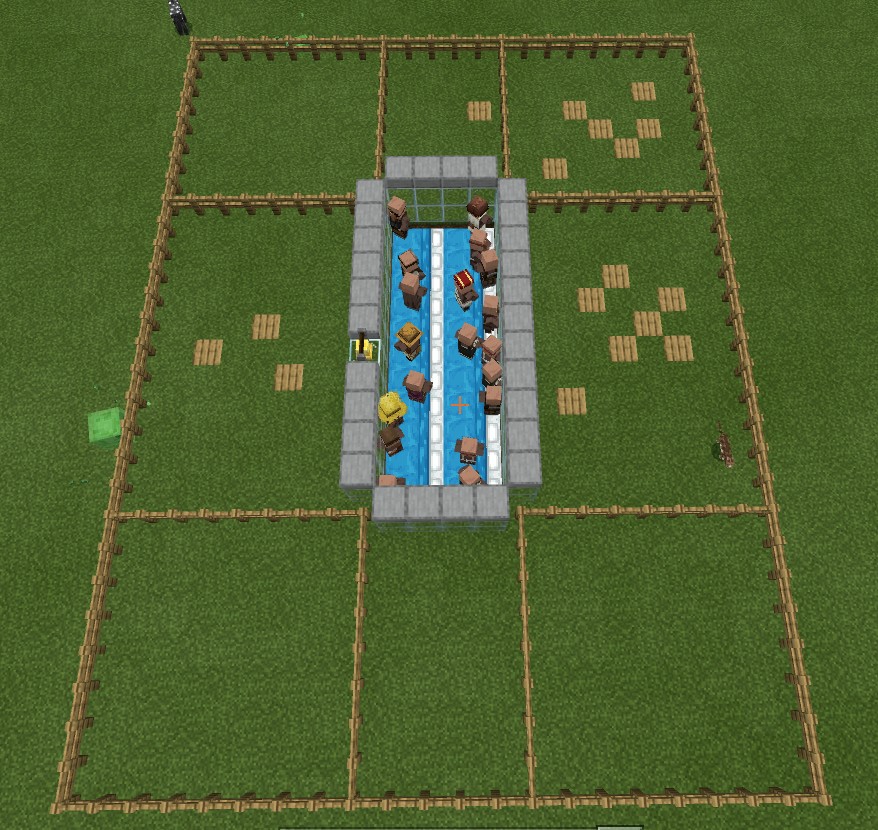
I built 4 simple experimental iron golem farms using beds and villagers, surrounded by 8 sectioned-off fenced areas to get an idea of the spawn distribution. The attached picture shows an example. I have watched over 30 golems (and even more cats) spawn over the past couple of days.
Observations:
- Not one single iron golem has spawned to the east of the beds, regardless of the orientation of the beds.
- Cats also never spawn to the east.
I believe my sample size is large enough to conclude that there's something odd about the spawn region for both cats and iron golems. It definitely isn't an equal probability area around the beds, or around the centroid of the beds.
The attached picture shows an example simple farm, with the wood slabs in the ground marking the spots where I observed an iron golem (which I then killed). Two spawned on top of the beds; those aren't marked. East is down, west is up. The distribution pretty clearly excludes the east.I noticed this when I tried to convert a naturally-generated village to an iron farm and saw that none of the golems were spawning in my planned farm area, but rather to the north and northwest of it. I had wondered if there was something about a naturally-generated village that would bias the golem spawn distribution, so built some farms in a flat world, and they also show a bias.
I built 4 simple experimental iron golem farms using beds and villagers, surrounded by 8 sectioned-off fenced areas to get an idea of the spawn distribution. The attached picture shows an example. I have watched over 30 golems (and even more cats) spawn over the past couple of days.
Observations:
- Not one single iron golem has spawned to the east of the beds, regardless of the orientation of the beds.
- Cats also never spawn to the east.
I believe my sample size is large enough to conclude that there's something odd about the spawn region for both cats and iron golems. It definitely isn't an equal probability area around the beds, or around the centroid of the beds.
Here's an example simple farm, with the wood slabs in the ground marking the spots where I observed an iron golem (which I then killed). Two spawned on top of the beds; those aren't marked. East is down, west is up. The distribution pretty clearly excludes the east.
That was pretty labor intensive, so I made an automated farm with two tiers of beds (12 on the bottom and 9 on top, total 21) and 10 villagers in the bottom tier, with a water trap and iron collector in each of the octants.
I left it running for over 10 hours and counted up the iron ingots collected:
16 beds I noticed this when I tried to convert a naturally-generated village to an iron farm and saw that none of the golems were spawning in my planned farm area, but rather to the north and northwest of it. I had wondered if there was something about a naturally-generated village that would bias the golem spawn distribution, so built some farms in a flat world, and they also show a bias.
I
built 4 simple experimental iron golem farms using beds and villagers, surrounded by 8 sectioned-off fenced areas to get an idea of the spawn distribution. The attached picture shows an example. I have watched over 30 golems (and even more cats) spawn over the past couple of days.Observations:
- Not one single iron golem
hasspawned to the east of the beds, regardless of the orientation of the beds.- Cats also never spawn to the east.
I
believe mysample sizeis large enough to conclude that there's something odd about the spawn region for both cats and iron golems. It definitely isn't an equal probability area around the beds, or around the centroid of the beds.Here's an example simple farm, with the wood slabs in the ground marking the spots where I observed an iron golem (which I then killed). Two spawned on top of the beds; those aren't marked. East is down, west is up. The distribution pretty clearly excludes the east.
That was pretty labor intensive, so I made an automated farm with two tiers of beds (12 on the bottom and 9 on top, total 21) and 10 villagers in the bottom tier, with a water trap and iron collector in each of the octants.
I left it running for over 10 hours and counted up the iron ingots collected:
16 beds
I noticed this when I tried to convert a naturally-generated village to an iron farm and saw that none of the golems were spawning in my planned farm area, but rather to the north and northwest of it. I had wondered iftherewas something about a naturally-generated village that would bias the golem spawn distribution, sobuilt some farms in a flat world, andthey also show a bias.I when I tried to convert a naturally-generated village to an iron farm and saw that none of the golems were spawning in my planned farm area, but rather to the north and northwest of it. I had wondered if there was something about a naturally-generated village that would bias the golem spawn distribution, so built some farms in a flat world, and they also show a bias.
I built 4 simple experimental iron golem farms using beds and villagers, surrounded by 8 sectioned-off fenced areas to get an idea of the spawn distribution. The attached picture shows an example. I have watched over 30 golems (and even more cats) spawn over the past couple of days.
Observations:
- Not one single iron golem spawned to the east of the beds, regardless of the orientation of the beds.
- Cats also never spawned to the east.
I thought sample size was large enough to conclude that there's something odd about the spawn region for both cats and iron golems. It definitely isn't an equal probability area around the beds, or around the centroid of the beds.
Here's an example simple farm, with the wood slabs in the ground marking the spots where I observed an iron golem (which I then killed). Two spawned on top of the beds; those aren't marked. East is down, west is up. The distribution pretty clearly excludes the east.
That was pretty labor intensive, so I made an automated farm with two tiers of beds (12 on the bottom and 9 on top, total 21) and 10 villagers in the bottom tier, with a water trap and iron collector in each of the octants.
I left it running for over 10 hours and counted up the iron ingots collected in each octant (north is up in this table):
13 16 3 26 beds 21 7 Here we have a bit more data. While there are a few ingots in the northeast and southeast, there's nothing directly east. Nothing from the southwest corner either, which I had thought was a fluke in my first experiment but seems to be confirmed here.
I when I tried to convert a naturally-generated village to an iron farm and saw that none of the golems were spawning in my planned farm area, but rather to the north and northwest of it. I had wondered if there was something about a naturally-generated village that would bias the golem spawn distribution, so built some farms in a flat world, and they also show a bias.
I built 4 simple
experimentaliron golem farms using beds and villagers, surrounded by 8 sectioned-off fenced areas to get an idea of the spawn distribution. The attached picture shows an example. I have watched over 30 golems (and even more cats) spawn over the past couple of days.Observations:
- Not one single iron golem spawned to the east of the beds, regardless of the orientation of the beds.
- Cats also never spawned to the east.
I thought sample size was large enough to conclude that there's something odd about the spawn region for both cats and iron golems. It definitely isn't an equal probability area around the beds, or around the centroid of the beds.
Here's an example simple farm, with the wood slabs in the ground marking the spots where I observed an iron golem (which I then killed). Two spawned on top of the beds; those aren't marked. East is down, west is up. The distribution pretty clearly excludes the east.
That was pretty labor intensive, so I made an automated farm with two tiers of beds (12 on the bottom and 9 on top, total 21) and 10 villagers in the bottom tier, with a water trap and iron collector in each of the octants.
I left it running for over 10 hours and counted up the iron ingots collected in each octant (north is up in this table):
13 16 3 26 beds 21 7 Here we have a bit more data. While there are a few ingots in the northeast and southeast, there's nothing directly east. Nothing from the southwest corner either, which I had thought was a fluke in my first experiment but seems to be confirmed here.
I when I tried to convert a naturally-generated village to an iron farm and saw that none of the golems were spawning in my planned farm area, but rather to the north and northwest of it. I had wondered if there was something about a naturally-generated village that would bias the golem spawn distribution, so I built some experimental farms in a flat world, and they also show a bias.
I built 4 simple iron golem farms using beds and villagers, surrounded by 8 sectioned-off fenced areas to get an idea of the spawn distribution. The attached picture shows an example. I have watched over 30 golems (and even more cats) spawn over the past couple of days.
Observations:
- Not one single iron golem spawned to the east of the beds, regardless of the orientation of the beds.
- Cats also never spawned to the east.
I thought sample size was large enough to conclude that there's something odd about the spawn region for both cats and iron golems. It definitely isn't an equal probability area around the beds, or around the centroid of the beds.
Here's an example simple farm, with the wood slabs in the ground marking the spots where I observed an iron golem (which I then killed). Two spawned on top of the beds; those aren't marked. East is down, west is up. The distribution pretty clearly excludes the east.
That was pretty labor intensive, so I made an automated farm with two tiers of beds (12 on the bottom and 9 on top, total 21) and 10 villagers in the bottom tier, with a water trap and iron collector in each of the octants.
I left it running for over 10 hours and counted up the iron ingots collected in each octant (north is up in this table):
13 16 3 26 beds 21 7 Here we have a bit more data. While there are a few ingots in the northeast and southeast, there's nothing directly east. Nothing from the southwest corner either, which I had thought was a fluke in my first experiment but seems to be confirmed here.
I when I tried to convert a naturally-generated village to an iron farm and saw that none of the golems were spawning in my planned farm area, but rather to the north and northwest of it. I had wondered if there was something about a naturally-generated village that would bias the golem spawn distribution, so I built some experimental farms in a flat world, and they also show a bias.
I built 4 simple iron golem farms using beds and villagers, surrounded by 8 sectioned-off fenced areas to get an idea of the spawn distribution. The attached picture shows an example. I have watched over 30 golems (and even more cats) spawn over the past couple of days.
Observations:
- Not one single iron golem spawned to the east of the beds, regardless of the orientation of the beds.
- Cats also never spawned to the east.
I thought sample size was large enough to conclude that there's something odd about the spawn region for both cats and iron golems. It definitely isn't an equal probability area around the beds, or around the centroid of the beds.
Here's an example simple farm, with the wood slabs in the ground marking the spots where I observed an iron golem (which I then killed). Two spawned on top of the beds; those aren't marked. East is down, west is up. The distribution pretty clearly excludes the east.
That was pretty labor intensive, so I made an automated farm with two tiers of beds (12 on the bottom and 9 on top, total 21) and 10 villagers in the bottom tier, with a water trap and iron collector in each of the octants.
I left it running for over 1
0hours and counted up the iron ingots collected in each octant (north is up in this table):
13 163 26 beds 21 7 Here we have a bit more data. While there are a few ingots in the northeast and southeast, there's nothing directly east. Nothing from the southwest corner either, which I had thought was a fluke in my first experiment but seems to be confirmed here.
I when I tried to convert a naturally-generated village to an iron farm and saw that none of the golems were spawning in my planned farm area, but rather to the north and northwest of it. I had wondered if there was something about a naturally-generated village that would bias the golem spawn distribution, so I built some experimental farms in a flat world, and they also show a bias.
I built 4 simple iron golem farms using beds and villagers, surrounded by 8 sectioned-off fenced areas to get an idea of the spawn distribution. The attached picture shows an example. I have watched over 30 golems (and even more cats) spawn over the past couple of days.
Observations:
- Not one single iron golem spawned to the east of the beds, regardless of the orientation of the beds.
- Cats also never spawned to the east.
I thought sample size was large enough to conclude that there's something odd about the spawn region for both cats and iron golems. It definitely isn't an equal probability area around the beds, or around the centroid of the beds.
Here's an example simple farm, with the wood slabs in the ground marking the spots where I observed an iron golem (which I then killed). Two spawned on top of the beds; those aren't marked. East is down, west is up. The distribution pretty clearly excludes the east.
That was pretty labor intensive, so I made an automated farm with two tiers of beds (12 on the bottom and 9 on top, total 21) and 10 villagers in the bottom tier, with a water trap and iron collector in each of the octants.
I left it running for over 15 hours and counted up the iron ingots collected in each octant (north is up in this table):
13 20 3 26 beds 21 7 Here we have a bit more data. While there are a few ingots in the northeast and southeast, there's nothing directly east. Nothing from the southwest corner either, which I had thought was a fluke in my first experiment but seems to be confirmed here.
I when I tried to convert a naturally-generated village to an iron farm and saw that none of the golems were spawning in my planned farm area, but rather to the north and northwest of it. I had wondered if there was something about a naturally-generated village that would bias the golem spawn distribution, so I built some experimental farms in a flat world, and they also show a bias.
I built 4 simple iron golem farms using beds and villagers, surrounded by 8 sectioned-off fenced areas to get an idea of the spawn distribution. The attached picture shows an example. I have watched over 30 golems (and even more cats) spawn over the past couple of days.
Observations:
- Not one single iron golem spawned to the east of the beds, regardless of the orientation of the beds.
- Cats also never spawned to the east.
I thought sample size was large enough to conclude that there's something odd about the spawn region for both cats and iron golems. It definitely isn't an equal probability area around the beds, or around the centroid of the beds.
Here's an example simple farm, with the wood slabs in the ground marking the spots where I observed an iron golem (which I then killed). Two spawned on top of the beds; those aren't marked. East is down, west is up. The distribution pretty clearly excludes the east.
That was pretty labor intensive, so I made an automated farm with two tiers of beds (12 on the bottom and 9 on top, total 21) and 10 villagers in the bottom tier, with a water trap and iron collector in each of the octants.
I left it running for over 15 hours and counted up the iron ingots collected in each octant (north is up in this table):
1 320 3 26beds 217Here we have a bit more data. While there are a few ingots in the northeast and southeast, there's nothing directly east.
Nothing from the southwest corner either, which I had thought was a fluke in my first experiment but seems to be confirmed here.I when I tried to convert a naturally-generated village to an iron farm and saw that none of the golems were spawning in my planned farm area, but rather to the north and northwest of it. I had wondered if there was something about a naturally-generated village that would bias the golem spawn distribution, so I built some experimental farms in a flat world, and they also show a bias.
I built 4 simple iron golem farms using beds and villagers, surrounded by 8 sectioned-off fenced areas to get an idea of the spawn distribution. The attached picture shows an example. I have watched over 30 golems (and even more cats) spawn over the past couple of days.
Observations:
- Not one single iron golem spawned to the east of the beds, regardless of the orientation of the beds.
- Cats also never spawned to the east.
I thought sample size was large enough to conclude that there's something odd about the spawn region for both cats and iron golems. It definitely isn't an equal probability area around the beds, or around the centroid of the beds.
Here's an example simple farm, with the wood slabs in the ground marking the spots where I observed an iron golem (which I then killed). Two spawned on top of the beds; those aren't marked. East is down, west is up. The distribution pretty clearly excludes the east.
That was pretty labor intensive, so I made an automated farm with two tiers of beds (12 on the bottom and 9 on top, total 21) and 10 villagers in the bottom tier, with a water trap and iron collector in each of the octants.
I left it running for over 15 hours and counted up the iron ingots collected in each octant (north is up in this table):
18 20 3 36 beds 27 34 11 Here we have a bit more data. While there are a few ingots in the northeast and southeast, there's nothing directly east.
I when I tried to convert a naturally-generated village to an iron farm and saw that none of the golems were spawning in my planned farm area, but rather to the north and northwest of it. I had wondered if there was something about a naturally-generated village that would bias the golem spawn distribution, so I built some experimental farms in a flat world, and they also show a bias.
I built 4 simple iron golem farms using beds and villagers, surrounded by 8 sectioned-off fenced areas to get an idea of the spawn distribution. The attached picture shows an example. I have watched over 30 golems (and even more cats) spawn over the past couple of days.
Observations:
- Not one single iron golem spawned to the east of the beds, regardless of the orientation of the beds.
- Cats also never spawned to the east.
I thought sample size was large enough to conclude that there's something odd about the spawn region for both cats and iron golems. It definitely isn't an equal probability area around the beds, or around the centroid of the beds.
Here's an example simple farm, with the wood slabs in the ground marking the spots where I observed an iron golem (which I then killed). Two spawned on top of the beds; those aren't marked. East is down, west is up. The distribution pretty clearly excludes the east.
That was pretty labor intensive, so I made an automated farm with two tiers of beds (12 on the bottom and 9 on top, total 21) and 10 villagers in the bottom tier, with a water trap and iron collector in each of the octants.
I left it running for over
15hours and counted up the iron ingots collected in each octant (north is up in this table):
18 2 03 36beds 273411 Here we have a bit more data. While there
area few ingots in the northeast and southeast, there's nothing directly east.I when I tried to convert a naturally-generated village to an iron farm and saw that none of the golems were spawning in my planned farm area, but rather to the north and northwest of it. I had wondered if there was something about a naturally-generated village that would bias the golem spawn distribution, so I built some experimental farms in a flat world, and they also show a bias.
I built 4 simple iron golem farms using beds and villagers, surrounded by 8 sectioned-off fenced areas to get an idea of the spawn distribution. The attached picture shows an example. I have watched over 30 golems (and even more cats) spawn over the past couple of days.
Observations:
- Not one single iron golem spawned to the east of the beds, regardless of the orientation of the beds.
- Cats also never spawned to the east.
I thought sample size was large enough to conclude that there's something odd about the spawn region for both cats and iron golems. It definitely isn't an equal probability area around the beds, or around the centroid of the beds.
Here's an example simple farm, with the wood slabs in the ground marking the spots where I observed an iron golem (which I then killed). Two spawned on top of the beds; those aren't marked. East is down, west is up. The distribution pretty clearly excludes the east.
That was pretty labor intensive, so I made an automated farm with two tiers of beds (12 on the bottom and 9 on top, total 21) and 10 villagers in the bottom tier, with a water trap and iron collector in each of the octants.
I left it running for over 32 hours and counted up the iron ingots collected in each octant (north is up in this table):
18 23 3 41 beds 5 41 51 11 Here we have a bit more data. While there a few ingots appeared in the northeast and southeast after about 12 hours, there's was nothing directly east for the first 24 hours running this test.
I when I tried to convert a naturally-generated village to an iron farm and saw that none of the golems were spawning in my planned farm area, but rather to the north and northwest of it. I had wondered if there was something about a naturally-generated village that would bias the golem spawn distribution, so I built some experimental farms in a flat world, and they also show a bias.
I built 4 simple iron golem farms using beds and villagers, surrounded by 8 sectioned-off fenced areas to get an idea of the spawn distribution. The attached picture shows an example. I have watched over 30 golems (and even more cats) spawn over the past couple of days.
Observations:
- Not one single iron golem spawned to the east of the beds, regardless of the orientation of the beds.
- Cats also never spawned to the east.
I thought sample size was large enough to conclude that there's something odd about the spawn region for both cats and iron golems. It definitely isn't an equal probability area around the beds, or around the centroid of the beds.
Here's an example simple farm, with the wood slabs in the ground marking the spots where I observed an iron golem (which I then killed). Two spawned on top of the beds; those aren't marked. East is down, west is up. The distribution pretty clearly excludes the east.
That was pretty labor intensive, so I made an automated farm with two tiers of beds (12 on the bottom and 9 on top, total 21) and 10 villagers in the bottom tier, with a water trap and iron collector in each of the octants.
I left it running for over 32 hours and counted up the iron ingots collected in each octant (north is up in this table):
18 2 3341 beds 541 51 1 1Here we have a bit more data. While there a few ingots appeared in the northeast and southeast after about 12 hours, there's was nothing directly east for the first 24 hours running this test.
I when I tried to convert a naturally-generated village to an iron farm and saw that none of the golems were spawning in my planned farm area, but rather to the north and northwest of it. I had wondered if there was something about a naturally-generated village that would bias the golem spawn distribution, so I built some experimental farms in a flat world, and they also show a bias.
I built 4 simple iron golem farms using beds and villagers, surrounded by 8 sectioned-off fenced areas to get an idea of the spawn distribution. The attached picture shows an example. I have watched over 30 golems (and even more cats) spawn over the past couple of days.
Observations:
- Not one single iron golem spawned to the east of the beds, regardless of the orientation of the beds.
- Cats also never spawned to the east.
I thought sample size was large enough to conclude that there's something odd about the spawn region for both cats and iron golems. It definitely isn't an equal probability area around the beds, or around the centroid of the beds.
Here's an example simple farm, with the wood slabs in the ground marking the spots where I observed an iron golem (which I then killed). Two spawned on top of the beds; those aren't marked. East is down, west is up. The distribution pretty clearly excludes the east.
That was pretty labor intensive, so I made an automated farm with two tiers of beds (12 on the bottom and 9 on top, total 21) and 10 villagers in the bottom tier, with a water trap and iron collector in each of the octants.
I left it running for over 32 hours and counted up the iron ingots collected in each octant (north is up in this table):
18 26 10 41 beds 9 41 51 15 Here we have a bit more data. While there a few ingots appeared in the northeast and southeast after about 12 hours, there's was nothing directly east for the first 24 hours running this test.
I when I tried to convert a naturally-generated village to an iron farm and saw that none of the golems were spawning in my planned farm area, but rather to the north and northwest of it. I had wondered if there was something about a naturally-generated village that would bias the golem spawn distribution, so I built some experimental farms in a flat world, and they also show a bias.
I built 4 simple iron golem farms using beds and villagers, surrounded by 8 sectioned-off fenced areas to get an idea of the spawn distribution. The attached picture shows an example. I have watched over 30 golems (and even more cats) spawn over the past couple of days.
Observations:
- Not one single iron golem spawned to the east of the beds, regardless of the orientation of the beds.
- Cats also never spawned to the east.
I thought sample size was large enough to conclude that there's something odd about the spawn region for both cats and iron golems. It definitely isn't an equal probability area around the beds, or around the centroid of the beds.
Here's an example simple farm, with the wood slabs in the ground marking the spots where I observed an iron golem (which I then killed). Two spawned on top of the beds; those aren't marked. East is down, west is up. The distribution pretty clearly excludes the east.
That was pretty labor intensive, so I made an automated farm with two tiers of beds (12 on the bottom and 9 on top, total 21) and 10 villagers in the bottom tier, with a water trap and iron collector in each of the octants.
I left it running for over
32hours and counted up the iron ingots collected in each octant (north is up in this table):
1826 10 4 1beds 9 4 151 15 Here we have a bit more data. While there a few ingots appeared in the northeast and southeast after about 12 hours, there's was nothing directly east for the first 24 hours running this test.
I when I tried to convert a naturally-generated village to an iron farm and saw that none of the golems were spawning in my planned farm area, but rather to the north and northwest of it. I had wondered if there was something about a naturally-generated village that would bias the golem spawn distribution, so I built some experimental farms in a flat world, and they also show a bias.
I built 4 simple iron golem farms using beds and villagers, surrounded by 8 sectioned-off fenced areas to get an idea of the spawn distribution. The attached picture shows an example. I have watched over 30 golems (and even more cats) spawn over the past couple of days.
Observations:
- Not one single iron golem spawned to the east of the beds, regardless of the orientation of the beds.
- Cats also never spawned to the east.
I thought sample size was large enough to conclude that there's something odd about the spawn region for both cats and iron golems. It definitely isn't an equal probability area around the beds, or around the centroid of the beds.
Here's an example simple farm, with the wood slabs in the ground marking the spots where I observed an iron golem (which I then killed). Two spawned on top of the beds; those aren't marked. East is down, west is up. The distribution pretty clearly excludes the east.
That was pretty labor intensive, so I made an automated farm with two tiers of beds (12 on the bottom and 9 on top, total 21) and 10 villagers in the bottom tier, with a water trap and iron collector in each of the octants.
I left it running for over 48 hours and counted up the iron ingots collected in each octant (north is up in this table):
23 26 10 46 beds 9 45 51 15 Here we have a bit more data. While there a few ingots appeared in the northeast and southeast after about 12 hours, there's was nothing directly east for the first 24 hours running this test.
I when I tried to convert a naturally-generated village to an iron farm and saw that none of the golems were spawning in my planned farm area, but rather to
the north and northwestof it. I had wondered if there was something about a naturally-generated village that would bias the golem spawn distribution, so I built some experimental farms in a flat world, and they also show a bias.I built 4 simple iron golem farms using beds and villagers, surrounded by 8 sectioned-off fenced areas to get an idea of the spawn distribution. The attached picture shows an example. I have watched over 30 golems (and even more cats) spawn over the past couple of days.
Observations:
- Not one single iron golem spawned to the east of the beds, regardless of the orientation of the beds.
- Cats also never spawned to the east.
I thought sample size was large enough to conclude that there's something odd about the spawn region for both cats and iron golems. It definitely isn't an equal probability area around the beds, or around the centroid of the beds.
Here's an example simple farm, with the wood slabs in the ground marking the spots where I observed an iron golem (which I then killed). Two spawned on top of the beds; those aren't marked. East is down, west is up. The distribution pretty clearly excludes the east.
That was pretty labor intensive, so I made an automated farm with two tiers of beds (12 on the bottom and 9 on top, total 21) and 10 villagers in the bottom tier, with a water trap and iron collector in each of the octants.
I left it running for over 48 hours and counted up the iron ingots collected in each octant (north is up in this table):
23261046beds9455115Here we have a bit more data. While there a few ingots appeared in the northeast and southeast after about 12 hours, there's was nothing directly east for the first 24 hours running this test.
I discovered this when I tried to convert a naturally-generated village to an iron farm and saw that none of the golems were spawning in my planned farm area, but rather to one side of it. I had wondered if there was something about a naturally-generated village that would bias the golem spawn distribution, so I built some experimental farms in a flat world, and they also show a bias.
I built 4 simple iron golem farms using beds and villagers, surrounded by 8 sectioned-off fenced areas to get an idea of the spawn distribution. The attached picture shows an example. I have watched over 30 golems (and even more cats) spawn over the past couple of days.
Observations:
- Not one single iron golem spawned to the east of the beds, regardless of the orientation of the beds.
- Cats also never spawned to the east.
I thought sample size was large enough to conclude that there's something odd about the spawn region for both cats and iron golems. It definitely isn't an equal probability area around the beds, or around the centroid of the beds.
Here's an example simple farm, with the wood slabs in the ground marking the spots where I observed an iron golem (which I then killed). Two spawned on top of the beds; those aren't marked. East is down, west is up. The distribution pretty clearly excludes the east.
That was pretty labor intensive, so I made an automated farm with two tiers of beds (12 on the bottom and 9 on top, total 21) and 10 villagers in the bottom tier, with a water trap and iron collector in each of the octants.
I left it running for over 48 hours and counted up the iron ingots collected in each octant (north is up in this table):
23 26 10 46 beds 9 45 51 15 Here we have a bit more data. While there a few ingots appeared in the northeast and southeast after about 12 hours, there's was nothing directly east for the first 24 hours running this test. About 70% of the ingots come from the west, southwest, and south.
I discovered this when I tried to convert a naturally-generated village to an iron farm and saw that none of the golems were spawning in my planned farm area, but rather to one side of it. I had wondered if there was something about a naturally-generated village that would bias the golem spawn distribution, so I built some experimental farms in a flat world, and they also show a bias.
I built 4 simple iron golem farms using beds and villagers, surrounded by 8 sectioned-off fenced areas to get an idea of the spawn distribution. The attached picture shows an example. I have watched over 30 golems (and even more cats) spawn over the past couple of days.
Observations:
- Not one single iron golem spawned to the east of the beds, regardless of the orientation of the beds.
- Cats also never spawned to the east.
I thought sample size was large enough to conclude that there's something odd about the spawn region for both cats and iron golems. It definitely isn't an equal probability area around the beds, or around the centroid of the beds.
Here's an example simple farm, with the wood slabs in the ground marking the spots where I observed an iron golem (which I then killed). Two spawned on top of the beds; those aren't marked. East is down, west is up. The distribution pretty clearly excludes the east.
That was pretty labor intensive, so I made an automated farm with two tiers of beds (12 on the bottom and 9 on top, total 21) and 10 villagers in the bottom tier, with a water trap and iron collector in each of the octants
.
I left it running for over 48 hours and counted up the iron ingots collected in each octant (north is up in this table):
23 26 10 46 beds 9 45 51 15 Here we have a bit more data. While there a few ingots appeared in the northeast and southeast after about 12 hours, there's was nothing directly east for the first 24 hours running this test. About 70% of the ingots come from the west, southwest, and south.
I discovered this when I tried to convert a naturally-generated village to an iron farm and saw that none of the golems were spawning in my planned farm area, but rather to one side of it. I had wondered if there was something about a naturally-generated village that would bias the golem spawn distribution, so I built some experimental farms in a flat world, and they also show a bias.
I built 4 simple iron golem farms using beds and villagers, surrounded by 8 sectioned-off fenced areas to get an idea of the spawn distribution. The attached picture shows an example. I have watched over 30 golems (and even more cats) spawn over the past couple of days.
Observations:
- Not one single iron golem spawned to the east of the beds, regardless of the orientation of the beds.
- Cats also never spawned to the east.
I thought sample size was large enough to conclude that there's something odd about the spawn region for both cats and iron golems. It definitely isn't an equal probability area around the beds, or around the centroid of the beds.
Here's an example simple farm, with the wood slabs in the ground marking the spots where I observed an iron golem (which I then killed). Two spawned on top of the beds; those aren't marked. East is down, west is up. The distribution pretty clearly excludes the east.
That was pretty labor intensive, so I made an automated farm with two tiers of beds (12 on the bottom and 9 on top, total 21) and 10 villagers in the bottom tier, with a water trap and iron collector in each of the octants (I eventually fenced in the whole thing because some golems would sneak out along the fences):
I left it running for over 48 hours and counted up the iron ingots collected in each octant (north is up in this table):
23 26 10 46 beds 9 45 51 15 Here we have a bit more data. While there a few ingots appeared in the northeast and southeast after about 12 hours, there's was nothing directly east for the first 24 hours running this test. About 70% of the ingots come from the west, southwest, and south.
I discovered this when I tried to convert a naturally-generated village to an iron farm and saw that none of the golems were spawning in my planned farm area, but rather to one side of it. I had wondered if there was something about a naturally-generated village that would bias the golem spawn distribution, so I built some experimental farms in a flat world, and they also show a bias.
I built 4 simple iron golem farms using beds and villagers, surrounded by 8 sectioned-off fenced areas to get an idea of the spawn distribution. The attached picture shows an example. I have watched over 30 golems (and even more cats) spawn over the past couple of days.
Observations:
- Not one single iron golem spawned to the east of the beds, regardless of the orientation of the beds.
- Cats also never spawned to the east.
I thought sample size was large enough to conclude that there's something odd about the spawn region for both cats and iron golems. It definitely isn't an equal probability area around the beds, or around the centroid of the beds.
Here's an example simple farm, with the wood slabs in the ground marking the spots where I observed an iron golem (which I then killed). Two spawned on top of the beds; those aren't marked. East is down, west is up. The distribution pretty clearly excludes the east.
That was pretty labor intensive, so I made an automated farm with two tiers of beds (12 on the bottom and 9 on top, total 21) and 10 villagers in the bottom tier, with a water trap and iron collector in each of the octants (I eventually fenced in the whole thing because some golems would sneak out along the fences):
I left it running for over 48 hours and countedup the ironingots collectedin each octant (north is up in this table):
23261046beds 9 455115
Here we have a bit more data. While there a few ingots appeared in thenortheast andsoutheast after about 12 hours, there's was nothing directly east for the first 24 hours running this test. About 70% of the ingots come from the west, southwest, and south.I discovered this when I tried to convert a naturally-generated village to an iron farm and saw that none of the golems were spawning in my planned farm area, but rather to one side of it. I had wondered if there was something about a naturally-generated village that would bias the golem spawn distribution, so I built some experimental farms in a flat world, and they also show a bias.
Experiment 1
I built 4 simple iron golem farms using beds and villagers, surrounded by 8 sectioned-off fenced areas to get an idea of the spawn distribution. The attached picture shows an example. I have watched over 30 golems (and even more cats) spawn over the past couple of days.
Observations:
- Not one single iron golem spawned to the east of the beds, regardless of the orientation of the beds.
- Cats also never spawned to the east.
I thought sample size was large enough to conclude that there's something odd about the spawn region for both cats and iron golems. It definitely isn't an equal probability area around the beds, or around the centroid of the beds.
Here's an example simple farm, with the wood slabs in the ground marking the spots where I observed an iron golem (which I then killed). Two spawned on top of the beds; those aren't marked. East is down, west is up. The distribution pretty clearly excludes the east.
Experiment 2
That was pretty labor intensive, so I made an automated farm with two tiers of beds (12 on the bottom and 9 on top, total 21) and 10 villagers in the bottom tier, with a water trap and iron collector in each of the octants (I eventually fenced in the whole thing because some golems would sneak out along the fences):
I left it running for over 48 hours and counted up the iron ingots collected in each octant (north is up in this table):
23 26 10 46 beds 9 45 51 15 Here we have a bit more data. While there a few ingots appeared in the northeast and southeast after about 12 hours, there's was nothing directly east for the first 24 hours running this test. About 70% of the ingots come from the west, southwest, and south.
This was still fairly labor intensive because golems often spawned inside the building (ignoring slabs) and also embedded in the ground, so I had to watch it to clear out the golem that spawned in the wrong place.
Experiment 3
Observing that the farm in experiment 2 had the intersection of four chunk boundaries among the beds (the farm was built around coordinate 0,0), I built another similar farm with the beds arranged squarely in the middle of a chunk, and let it run for a full day, monitoring it closely. This time the beds were 1 block higher relative to the water trap. I still got golems spawning in the building, but no more spawned embedded in the ground.
The distribution bias was even more pronounced. Zero ingots collected to the south. Very few to the southeast and southwest. After 24 hours, the ingots were distributed like this:
50 61 37 66 beds 29 10 0 7 About 70% of the ingots come from the west, northwest, and north. Less than 7% come from the southern sections, with zero ingots collected due south of the beds.
I discovered this when I tried to convert a naturally-generated village to an iron farm and saw that none of the golems were spawning in my planned farm area, but rather to one side of it. I had wondered if there was something about a naturally-generated village that would bias the golem spawn distribution, so I built some experimental farms in a flat world, and they also show a bias.
Experiment 1
I built 4 simple iron golem farms using beds and villagers, surrounded by 8 sectioned-off fenced areas to get an idea of the spawn distribution. The attached picture shows an example. I have watched over 30 golems (and even more cats) spawn over the past couple of days.
Observations:
- Not one single iron golem spawned to the east of the beds, regardless of the orientation of the beds.
- Cats also never spawned to the east.
I thought sample size was large enough to conclude that there's something odd about the spawn region for both cats and iron golems. It definitely isn't an equal probability area around the beds, or around the centroid of the beds.
Here's an example simple farm, with the wood slabs in the ground marking the spots where I observed an iron golem (which I then killed). Two spawned on top of the beds; those aren't marked. East is down, west is up. The distribution pretty clearly excludes the east.
East is down in this image.Experiment 2
That was pretty labor intensive, so I made an automated farm with two tiers of beds (12 on the bottom and 9 on top, total 21) and 10 villagers in the bottom tier, with a water trap and iron collector in each of the octants (I eventually fenced in the whole thing because some golems would sneak out along the fences):
North is up in this image.I left it running for over 48 hours and counted up the iron ingots collected in each octant (north is up in this table):
23 26 10 46 beds 9 45 51 15 Here we have a bit more data. While there a few ingots appeared in the northeast and southeast after about 12 hours, there's was nothing directly east for the first 24 hours running this test. About 70% of the ingots come from the west, southwest, and south.
This was still fairly labor intensive because golems often spawned inside the building (ignoring slabs) and also embedded in the ground, so I had to watch it to clear out the golem that spawned in the wrong place.
Experiment 3
Observing that the farm in experiment 2 had the intersection of four chunk boundaries among the beds (the farm was built around coordinate 0,0), I built another similar farm with the beds arranged squarely in the middle of a chunk, and let it run for a full day, monitoring it closely. This time the beds were 1 block higher relative to the water trap. I still got golems spawning in the building, but no more spawned embedded in the ground.
The distribution bias was even more pronounced. Zero ingots collected to the south. Very few to the southeast and southwest. After 24 hours, the ingots were distributed like this:
50 61 37 66 beds 29 10 0 7 About 70% of the ingots come from the west, northwest, and north. Less than 7% come from the southern sections, with zero ingots collected due south of the beds.
I discovered this when I tried to convert a naturally-generated village to an iron farm and saw that none of the golems were spawning in my planned farm area, but rather to one side of it. I had wondered if there was something about a naturally-generated village that would bias the golem spawn distribution, so I built some experimental farms in a flat world, and they also show a bias.
Experiment 1
I built 4 simple iron golem farms using beds and villagers, surrounded by 8 sectioned-off fenced areas to get an idea of the spawn distribution. The attached picture shows an example. I have watched over 30 golems (and even more cats) spawn over the past couple of days.
Observations:
- Not one single iron golem spawned to the east of the beds, regardless of the orientation of the beds.
- Cats also never spawned to the east.
I thought sample size was large enough to conclude that there's something odd about the spawn region for both cats and iron golems. It definitely isn't an equal probability area around the beds, or around the centroid of the beds.
Here's an example simple farm, with the wood slabs in the ground marking the spots where I observed an iron golem (which I then killed). Two spawned on top of the beds; those aren't marked. East is down, west is up. The distribution pretty clearly excludes the east.
East is down in this image.Experiment 2
That was pretty labor intensive, so I made an automated farm with two tiers of beds (12 on the bottom and 9 on top, total 21) and 10 villagers in the bottom tier, with a water trap and iron collector in each of the octants (I eventually fenced in the whole thing because some golems would sneak out along the fences):
North is up in this image.I left it running for over 48 hours and counted up the iron ingots collected in each octant (north is up in this table):
23 26 10 46 beds 9 45 51 15 Here we have a bit more data. While there a few ingots appeared in the northeast and southeast after about 12 hours, there's was nothing directly east for the first 24 hours running this test. About 70% of the ingots come from the west, southwest, and south.
This was still fairly labor intensive because golems often spawned inside the building (ignoring slabs) and also embedded in the ground, so I had to watch it to clear out
thegolem that spawned in the wrong place.Experiment 3
Observing that the farm in experiment 2 had the intersection of four chunk boundaries among the beds (the farm was built around coordinate 0,0), I built another similar farm with the beds arranged squarely in the middle of a chunk, and let it run for a full day, monitoring it closely. This time the beds were 1 block higher relative to the water trap. I still got golems spawning in the building, but no more spawned embedded in the ground.
The distribution bias was even more pronounced. Zero ingots collected to the south. Very few to the southeast and southwest. After 24 hours, the ingots were distributed like this:
50 61 37 66 beds 29 10 0 7 About 70% of the ingots come from the west, northwest, and north. Less than 7% come from the southern sections, with zero ingots collected due south of the beds.
I discovered this when I tried to convert a naturally-generated village to an iron farm and saw that none of the golems were spawning in my planned farm area, but rather to one side of it. I had wondered if there was something about a naturally-generated village that would bias the golem spawn distribution, so I built some experimental farms in a flat world, and they also show a bias.
Experiment 1
I built 4 simple iron golem farms using beds and villagers, surrounded by 8 sectioned-off fenced areas to get an idea of the spawn distribution. The attached picture shows an example. I have watched over 30 golems (and even more cats) spawn over the past couple of days.
Observations:
- Not one single iron golem spawned to the east of the beds, regardless of the orientation of the beds.
- Cats also never spawned to the east.
I thought sample size was large enough to conclude that there's something odd about the spawn region for both cats and iron golems. It definitely isn't an equal probability area around the beds, or around the centroid of the beds.
Here's an example simple farm, with the wood slabs in the ground marking the spots where I observed an iron golem (which I then killed). Two spawned on top of the beds; those aren't marked. East is down, west is up. The distribution pretty clearly excludes the east.
East is down in this image.Experiment 2
That was pretty labor intensive, so I made an automated farm with two tiers of beds (12 on the bottom and 9 on top, total 21) and 10 villagers in the bottom tier, with a water trap and iron collector in each of the octants (I eventually fenced in the whole thing because some golems would sneak out along the fences):
North is up in this image.I left it running for over 48 hours and counted up the iron ingots collected in each octant (north is up in this table):
23 26 10 46 beds 9 45 51 15 Here we have a bit more data. While there a few ingots appeared in the northeast and southeast after about 12 hours, there's was nothing directly east for the first 24 hours running this test. About 70% of the ingots come from the west, southwest, and south.
This was still fairly labor intensive because golems often spawned inside the building (ignoring slabs) and also embedded in the ground, so I had to watch it to clear out golems that spawned in the wrong place.
Experiment 3
Observing that the farm in experiment 2 had the intersection of four chunk boundaries among the beds (the farm was built around coordinate 0,0), I built another similar farm with the beds arranged squarely in the middle of a chunk, and let it run for a full day, monitoring it closely. This time the beds were 1 block higher relative to the water trap. I still got golems spawning in the building, but no more spawned embedded in the ground.
The distribution bias was even more pronounced. Zero ingots collected to the south. Very few to the southeast and southwest. After 24 hours, the ingots were distributed like this:
50 61 37 66 beds 29 10 0 7 About 70% of the ingots come from the west, northwest, and north. Less than 7% come from the southern sections, with zero ingots collected due south of the beds.
I'm wondering now if the nonuniform distribution might be due to chunk boundaries dividing up the building with the beds.
I discovered this when I tried to convert a naturally-generated village to an iron farm and saw that none of the golems were spawning in my planned farm area, but rather to one side of it. I had wondered if there was something about a naturally-generated village that would bias the golem spawn distribution, so I built some experimental farms in a flat world, and they also show a bias.
Experiment 1
I built 4 simple iron golem farms using beds and villagers, surrounded by 8 sectioned-off fenced areas to get an idea of the spawn distribution. The attached picture shows an example. I have watched over 30 golems (and even more cats) spawn over the past couple of days.
Observations:
- Not one single iron golem spawned to the east of the beds, regardless of the orientation of the beds.
- Cats also never spawned to the east.
I thought sample size was large enough to conclude that there's something odd about the spawn region for both cats and iron golems. It definitely isn't an equal probability area around the beds, or around the centroid of the beds.
Here's an example simple farm, with the wood slabs in the ground marking the spots where I observed an iron golem (which I then killed). Two spawned on top of the beds; those aren't marked. East is down, west is up. The distribution pretty clearly excludes the east.
East is down in this image.Experiment 2
That was pretty labor intensive, so I made an automated farm with two tiers of beds (12 on the bottom and 9 on top, total 21) and 10 villagers in the bottom tier, with a water trap and iron collector in each of the octants (I eventually fenced in the whole thing because some golems would sneak out along the fences):
North is up in this image.I left it running for over 48 hours and counted up the iron ingots collected in each octant (north is up in this table):
23 26 10 46 beds 9 45 51 15 Here we have a bit more data. While there a few ingots appeared in the northeast and southeast after about 12 hours, there's was nothing directly east for the first 24 hours running this test. About 70% of the ingots come from the west, southwest, and south.
This was still fairly labor intensive because golems often spawned inside the building (ignoring slabs) and also embedded in the ground, so I had to watch it to clear out golems that spawned in the wrong place.
Experiment 3
Observing that the farm in experiment 2 had the intersection of four chunk boundaries among the beds (the farm was built around coordinate 0,0), I built another similar farm with the beds arranged squarely in the middle of a chunk, and let it run for a full day, monitoring it closely. This time the beds were 1 block higher relative to the water trap. I still got golems spawning in the building, but no more spawned embedded in the ground.
The distribution bias was even more pronounced. Zero ingots collected to the south. Very few to the southeast and southwest. After 24 hours, the ingots were distributed like this:
50 61 37 66 beds 29 10 0 7 About 70% of the ingots come from the west, northwest, and north. Less than 7% come from the southern sections, with zero ingots collected due south of the beds.
(update 11 June 2019) Moderator: please close this. The problem I describe below turns out to be due to one of the beds being designated as the village center, which biases the spawn distribution asymmetrically. The village center is not the geometric center of the beds, it's one particular bed. I don't know if that's a bug, or if it's by design. Any enlightening comments when closing are appreciated!
Original descriptionI discovered this when I tried to convert a naturally-generated village to an iron farm and saw that none of the golems were spawning in my planned farm area, but rather to one side of it. I had wondered if there was something about a naturally-generated village that would bias the golem spawn distribution, so I built some experimental farms in a flat world, and they also show a bias.
Experiment 1
I built 4 simple iron golem farms using beds and villagers, surrounded by 8 sectioned-off fenced areas to get an idea of the spawn distribution. The attached picture shows an example. I have watched over 30 golems (and even more cats) spawn over the past couple of days.
Observations:
- Not one single iron golem spawned to the east of the beds, regardless of the orientation of the beds.
- Cats also never spawned to the east.
I thought sample size was large enough to conclude that there's something odd about the spawn region for both cats and iron golems. It definitely isn't an equal probability area around the beds, or around the centroid of the beds.
Here's an example simple farm, with the wood slabs in the ground marking the spots where I observed an iron golem (which I then killed). Two spawned on top of the beds; those aren't marked. East is down, west is up. The distribution pretty clearly excludes the east.
East is down in this image.Experiment 2
That was pretty labor intensive, so I made an automated farm with two tiers of beds (12 on the bottom and 9 on top, total 21) and 10 villagers in the bottom tier, with a water trap and iron collector in each of the octants (I eventually fenced in the whole thing because some golems would sneak out along the fences):
North is up in this image.I left it running for over 48 hours and counted up the iron ingots collected in each octant (north is up in this table):
23 26 10 46 beds 9 45 51 15 Here we have a bit more data. While there a few ingots appeared in the northeast and southeast after about 12 hours, there's was nothing directly east for the first 24 hours running this test. About 70% of the ingots come from the west, southwest, and south.
This was still fairly labor intensive because golems often spawned inside the building (ignoring slabs) and also embedded in the ground, so I had to watch it to clear out golems that spawned in the wrong place.
Experiment 3
Observing that the farm in experiment 2 had the intersection of four chunk boundaries among the beds (the farm was built around coordinate 0,0), I built another similar farm with the beds arranged squarely in the middle of a chunk, and let it run for a full day, monitoring it closely. This time the beds were 1 block higher relative to the water trap. I still got golems spawning in the building, but no more spawned embedded in the ground.
The distribution bias was even more pronounced. Zero ingots collected to the south. Very few to the southeast and southwest. After 24 hours, the ingots were distributed like this:
50 61 37 66 beds 29 10 0 7 About 70% of the ingots come from the west, northwest, and north. Less than 7% come from the southern sections, with zero ingots collected due south of the beds.
The seed picker appears blank for me. See attached screenshot. This started in 1.16.0 and continues in 1.16.1.
The really strange thing is, when my son logs into his account on the same laptop and runs Minecraft, the seed picker has content. However, he says Minecraft 1.16.1 on his iPad also shows an empty seed picker.
I see a related issue
MCPE-84668resolved as incomplete. I'd re-open that one if I could, but I can't, so I'm creating this ticket.Update 13 July 2020: Today, the seed picker appeared with seeds. There have been no updates. Yesterday the seed picker was empty for me after restarting Minecraft twice, but showed seeds when my son ran Minecraft after logging into the same laptop with his account. I expect this bug is going to be difficult to reproduce.
The seed picker appears blank for me. See attached screenshot. This started in 1.16.0 and continues in 1.16.1.
The really strange thing is, when my son logs into his account on the same laptop and runs Minecraft, the seed picker has content. However, he says Minecraft 1.16.1 on his iPad also shows an empty seed picker.
I see a related issue
MCPE-84668resolved as incomplete. I'd re-open that one if I could, but I can't, so I'm creating this ticket.Update 13 July 2020: Today, the seed picker appeared with seeds. There have been no updates. Yesterday the seed picker was empty for me after restarting Minecraft twice, but showed seeds when my son ran Minecraft after logging into the same laptop with his account (and then empty again when I logged in and tried it). But today it's working. I expect this bug is going to be difficult to reproduce.
Today in my survival game (hard mode) I observed that a zombie spawner never stops making zombies even if the population of converted drowned rises well above any mob cap that may be in effect. I haven't noticed this happening until recently. I also haven't spent much time in my zombie farm lately (it's this flooded dungeon drowned farm, actually) so I don't know when this started happening.
The attached pictures show (a) a view of the drowning room with what seems to be about 50 drowned crowded into it, most of them packed into the left end, and (b) the spawner dungeon room crowded with drowned that managed to climb on top of other drowned to get back into the room from the drowning room below (with a couple of zombies visible).
This farm is beyond the despawning range from my home base, so whenever I visit the farm, it's empty but starts producing zombies when I arrive. Today I decided not to harvest any of the converted drowned, but instead manage the items in the collection chest: smelting gold and chainmail armor into nuggets, keeping a few interesting enchanted pieces and discarding the rest, to clear out the collection chest. At this point I'm using the farm only as an inefficient source of iron because I'm playing an island survival game ("Ocean Monument Ahead" seed from the seed picker) and there are no villages around to construct a real iron farm, and I've already mined much of the iron around my area.
After about 30 minutes or so, I observed the both the spawner room and drowning chamber utterly packed with drowned and a few zombies.
Today in my survival game (hard mode) I observed that a zombie spawner never stops making zombies even if the population of converted drowned rises well above any mob cap that may be in effect. I haven't noticed this happening until recently. I also haven't spent much time in my zombie farm lately (it's this flooded dungeon drowned farm, actually) so I don't know when this started happening.
The attached pictures show (a) a view of the drowning room with what seems to be about 50 drowned crowded into it, most of them packed into the left end, and (b) the spawner dungeon room crowded with drowned that managed to climb on top of other drowned to get back into the room from the drowning room below (with a
couple ofzombies visible).This farm is beyond the despawning range from my home base, so whenever I visit the farm, it's empty but starts producing zombies when I arrive. Today I decided not to harvest any of the converted drowned, but instead manage the items in the collection chest: smelting gold and chainmail armor into nuggets, keeping a few interesting enchanted pieces and discarding the rest, to clear out the collection chest. At this point I'm using the farm only as an inefficient source of iron because I'm playing an island survival game ("Ocean Monument Ahead" seed from the seed picker) and there are no villages around to construct a real iron farm, and I've already mined much of the iron around my area.
After about 30 minutes or so, I observed the both the spawner room and drowning chamber utterly packed with drowned and a few zombies.
Today in my survival game (hard mode) I observed that a zombie spawner never stops making zombies even if the population of converted drowned rises well above any mob cap that may be in effect. I haven't noticed this happening until recently. I also haven't spent much time in my zombie farm lately (it's this flooded dungeon drowned farm, actually) so I don't know when this started happening.
The attached pictures show (a) a view of the drowning room with what seems to be about 50 drowned crowded into it, most of them packed into the left end, and (b) the spawner dungeon room crowded with over 40 drowned that managed to climb on top of other drowned to get back into the room from the drowning room below (with a few zombies visible).
This farm is beyond the despawning range from my home base, so whenever I visit the farm, it's empty but starts producing zombies when I arrive. Today I decided not to harvest any of the converted drowned, but instead manage the items in the collection chest: smelting gold and chainmail armor into nuggets, keeping a few interesting enchanted pieces and discarding the rest, to clear out the collection chest. At this point I'm using the farm only as an inefficient source of iron because I'm playing an island survival game ("Ocean Monument Ahead" seed from the seed picker) and there are no villages around to construct a real iron farm, and I've already mined much of the iron around my area.
After about 30 minutes or so, I observed the both the spawner room and drowning chamber utterly packed with drowned and a few zombies.
Today in my survival game (hard mode) I observed that a zombie spawner never stops making zombies even if the population of converted drowned rises well above any mob cap that may be in effect. I haven't noticed this happening until recently. I also haven't spent much time in my zombie farm lately (it's this flooded dungeon drowned farm, actually) so I don't know when this started happening.
The attached pictures show (a) a view of the drowning room with what seems to be about 50 drowned crowded into it, most of them packed into the left end, and (b) the spawner dungeon room crowded with over 40 drowned that managed to climb on top of other drowned to get back into the room from the drowning room below (with a few zombies visible).
This farm is beyond the despawning range from my home base, so whenever I visit the farm, it's empty but starts producing zombies when I arrive. Today I decided not to harvest any of the converted drowned, but instead manage the items in the collection chest: smelting gold and chainmail armor into nuggets, keeping a few interesting enchanted pieces and discarding the rest, to clear out the collection chest. At this point I'm using the farm only as an inefficient source of iron because I'm playing an island survival game ("Ocean Monument Ahead" seed from the seed picker) and there are no villages around to construct a real iron farm, and I've already mined much of the iron around my area.
After about 30 minutes or so, I observed the both the spawner room and drowning chamber utterly packed with drowned and a few zombies.
Today in my survival game (hard mode) I observed that a zombie spawner never stops making zombies even if the population of converted drowned rises well above any mob cap that may be in effect. I haven't noticed this happening until recently. I also haven't spent much time in my zombie farm lately (it's this flooded dungeon drowned farm, actually) so I don't know when this started happening.
The attached pictures show (a) a view of the drowning room with what seems to be about 50 drowned crowded into it, most of them packed into the left end, and (b) the spawner dungeon room crowded with over 40 drowned that managed to climb on top of other drowned to get back into the room from the drowning room below (with a few zombies visible). It took probably 30-45 minutes to accumulate this many.
This farm is beyond the despawning range from my home base, so whenever I visit the farm, it's empty but starts producing zombies when I arrive. Today I decided not to harvest any of the converted drowned, but instead manage the items in the collection chest: smelting gold and chainmail armor into nuggets, keeping a few interesting enchanted pieces and discarding the rest, to clear out the collection chest. At this point I'm using the farm only as an inefficient source of iron because I'm playing an island survival game ("Ocean Monument Ahead" seed from the seed picker) and there are no villages around to construct a real iron farm, and I've already mined much of the iron around my area.
Today in my survival game (hard mode) I observed that a zombie spawner never stops making zombies even if the population of converted drowned rises well above any mob cap that may be in effect. I haven't noticed this happening until recently. I also haven't spent much time in my zombie farm lately (it's this flooded dungeon drowned farm, actually) so I don't know when this started happening.
The attached pictures show (a) a view of the drowning room with what seems to be about 50 drowned crowded into it, most of them packed into the left end, and (b) the spawner dungeon room crowded with over 40 drowned that managed to climb on top of other drowned to get back into the room from the drowning room below (with a few zombies visible). It took probably 30-45 minutes to accumulate this many.
This farm is beyond the despawning range from my home base, so whenever I visit the farm, it's empty but starts producing zombies when I arrive. Today I decided not to harvest any of the converted drowned, but instead manage the items in the collection chest: smelting gold and chainmail armor into nuggets, keeping a few interesting enchanted pieces and discarding the rest
, to clear out the collection chest. At this point I'm using the farm only as an inefficient source of iron because I'm playing an island survival game ("Ocean Monument Ahead" seed from the seed picker) and there are no villages around to construct a real iron farm, and I've already mined much of the iron around my area.Today in my survival game (hard mode) I observed that a zombie spawner never stops making zombies even if the population of converted drowned rises well above any mob cap that may be in effect. I haven't noticed this happening until recently. I also haven't spent much time in my zombie farm lately (it's this flooded dungeon drowned farm, actually) so I don't know when this started happening.
Today I decided not to harvest any of the converted drowned, but instead manage the items in the collection chest: smelting gold and chainmail armor into nuggets, keeping a few interesting enchanted pieces and discarding the rest. After 30-45 minutes I took the attached screenshots, showing (a) a view of the drowning room with what seems to be about 50 drowned crowded into it, most of them packed into the left end, and (b) the spawner dungeon room crowded with over 40 drowned that managed to climb on top of other drowned to get back into the room from the drowning room below (with a few zombies visible). It took probably 30-45 minutes to accumulate this many.
This farm is beyond the despawning range from my home base, so whenever I visit the farm, it's empty but starts producing zombies when I arrive. At this point I'm using the farm only as an inefficient source of iron because I'm playing an island survival game ("Ocean Monument Ahead" seed from the seed picker) and there are no villages around to construct a real iron farm, and I've already mined much of the iron around my area.
Today in my survival game (hard mode) I observed that a zombie spawner never stops making zombies even if the population of converted drowned rises well above any mob cap that may be in effect. I haven't noticed this happening until recently. I also haven't spent much time in my zombie farm lately (it's this flooded dungeon drowned farm, actually) so I don't know when this started happening.Today I decided not to harvest any of the converted drowned, but instead manage the items in the collection chest: smelting gold and chainmail armor into nuggets, keeping a few interesting enchanted pieces and discarding the rest. After 30-45 minutes I took the attached screenshots, showing (a) a view of the drowning room with what seems to be about 50 drowned crowded into it, most of them packed into the left end, and (b) the spawner dungeon room crowded with over 40 drowned that managed to climb on top of other drowned to get back into the room from the drowning room below (with a few zombies visible). It took probably 30-45 minutes to accumulate this many.
This farm is beyond the despawning range from my home base, so whenever I visit the farm, it's empty but starts producing zombies when I arrive. At this point I'm using the farm only as an inefficient source of iron because I'm playing an island survival game ("Ocean Monument Ahead" seed from the seed picker) and there are no villages around to construct a real iron farm, and I've already mined much of the iron around my area.
In my survival game (hard mode) I observed that a zombie spawner never stops making zombies even if the population of converted drowned rises well above any mob cap that may be in effect. I haven't noticed this happening until recently. I also haven't spent much time in my zombie farm lately (it's this flooded dungeon drowned farm, actually) so I don't know when this started happening.
Instead of harvesting any of the converted drowned, I decided instead to manage the items in the collection chest: smelting gold and chainmail armor into nuggets, keeping a few interesting enchanted pieces and discarding the rest. After 30-45 minutes I took the attached screenshots, showing (a) a view of the drowning room with what seems to be about 50 drowned crowded into it, most of them packed into the left end, and (b) the spawner dungeon room crowded with over 40 drowned that managed to climb on top of other drowned to get back into the room from the drowning room below (with a few zombies visible). It took probably 30-45 minutes to accumulate this many.
This farm is beyond the despawning range from my home base, so whenever I visit the farm, it's empty but starts producing zombies when I arrive. At this point I'm using the farm only as an inefficient source of iron because I'm playing an island survival game ("Ocean Monument Ahead" seed from the seed picker) and there are no villages around to construct a real iron farm, and I've already mined much of the iron around my area.
In my survival game (hard mode) I observed that a zombie spawner never stops making zombies even if the population of converted drowned rises well above any mob cap that may be in effect. I haven't noticed this happening until recently. I also haven't spent much time in my
zombie farm lately (it'sthisflooded dungeon drowned farm,actually)so I don't know when this started happening.Instead of harvesting any of the converted drowned, I decided instead to manage the items in the collection chest: smelting gold and chainmail armor into nuggets, keeping a few interesting enchanted pieces and discarding the rest. After 30-45 minutes I took the attached screenshots, showing (a) a view of the drowning room with what seems to be about 50 drowned crowded into it, most of them packed into the left end, and (b) the spawner dungeon room crowded with over 40 drowned that managed to climb on top of other drowned to get back into the room from the drowning room below (with a few zombies visible). It took probably 30-45 minutes to accumulate this many.
This farm is beyond the despawning range from my home base, so whenever I visit the farm, it's empty but starts producing zombies when I arrive. At this point I'm using the farm only as an inefficient source of iron because I'm playing an island survival game ("Ocean Monument Ahead" seed from the seed picker) and there are no villages around to construct a real iron farm, and I've already mined much of the iron around my area.
In my survival game (hard mode) I observed that a zombie spawner never stops making zombies even if the population of converted drowned rises well above any mob cap that may be in effect. I haven't noticed this happening until recently. I also haven't spent much time in my flooded dungeon drowned farm, so I don't know when this started happening.
Instead of harvesting any of the converted drowned, I decided instead to manage the items in the collection chest: smelting gold and chainmail armor into nuggets, keeping a few interesting enchanted pieces and discarding the rest. After 30-45 minutes I took the attached screenshots, showing (a) a view of the drowning room with what seems to be about 50 drowned crowded into it, most of them packed into the left end, and (b) the spawner dungeon room crowded with over 40 drowned that managed to climb on top of other drowned to get back into the room from the drowning room below (with a few zombies visible). It took probably 30-45 minutes to accumulate this many.
This farm is beyond the despawning range from my home base, so whenever I visit the farm, it's empty but starts producing zombies when I arrive. At this point I'm using the farm only as an inefficient source of iron because I'm playing an island survival game ("Ocean Monument Ahead" seed from the seed picker) and there are no villages around to construct a real iron farm, and I've already mined much of the iron around my area.
Update: Still happening in 1.17.0.
Steps:
- Create a flat world in Creative Peaceful difficulty.
- Dig a 5x5 pool 1 block deep and fill it with water.
- Put three axolotls in the pool.
- Wait.
The axolotls leave the water and wander off, sometimes returning
, but sometimes not returning in time before dying. I observed one meander back to the pool, but when it was two blocks away, it veered off andwandered away and then flashed red and died - it could have made it back to the water easily.Possibly related to MC-228464.
Steps:
- Create a flat world in Creative Peaceful difficulty.
- Dig a 5x5 pool 1 block deep and fill it with water.
- Put three axolotls in the pool.
- Wait.
Expected: Axolotls return to the water in time to save themselves from dying.
Actual: Eventually all the axolotls are dead.
The axolotls leave the water and wander off, sometimes returning to the water before leaving again. Or they just wander off and die. I observed one meander back to the pool, but when it was two blocks away, it veered off and ambled away, and then flashed red and died - it could have made it back to the water easily.
Possibly related to MC-228464.
Steps:
- Create a flat world in Creative Peaceful difficulty.
- Dig a 5x5 pool 1 block deep and fill it with water. Put some tropical fish in the pool (not necessary but fun to watch in the next step).
- Put three axolotls in the pool.
- Fly up until the axolotls don't notice you.
- Wait.
Expected: Axolotls return to the water in time to save themselves from dying.
Actual: Eventually all the axolotls are dead.
The axolotls leave the water and wander off, sometimes returning to the water before leaving again. Or they just wander off and die. I observed one meander back to the pool, but when it was two blocks away, it veered off and ambled away, and then flashed red and died - it could have made it back to the water easily.
Possibly related to MC-228464.
Steps:
- Create a flat world in Creative Peaceful difficulty.
- Dig a 5x5 pool 1 block deep and fill it with water. Put some tropical fish in the pool (not necessary but fun to watch in the next step).
- Put three axolotls in the pool.
- Fly up until the axolotls don't notice you.
- Wait.
Expected: Axolotls return to the water in time to save themselves from dying.
Actual: Eventually all the axolotls are dead.
The axolotls leave the water and wander off, sometimes returning to the water before leaving again. Or they just wander off and die. I observed one meander back to the pool, but when it was two blocks away, it veered off and ambled away, and then flashed red and died - it could have made it back to the water easily.
Possibly related to MC-228464.
Steps:
- Create a flat world in Creative Peaceful difficulty.
- Dig a 5x5 pool 1 block deep and fill it with water. Put some tropical fish in the pool (not necessary but fun to watch in the next step).
- Put three axolotls in the pool.
- Fly up until the axolotls don't notice you.
- Wait.
Expected: Axolotls return to the water in time to save themselves from dying. Or, they don't venture away from water farther than some reasonable distance.
Actual: Eventually all the axolotls are dead.
The axolotls leave the water and wander off, sometimes returning to the water before leaving again. Or they just wander off and die. I observed one meander back to the pool, but when it was two blocks away, it veered off and ambled away, and then flashed red and died - it could have made it back to the water easily.
Possibly related to MC-228464.
Axolotls leaving watersometimesdon't pathfind back
Steps:
- Create a flat world in Creative Peaceful difficulty.
- Dig a 5x5 pool 1 block deep and fill it with water. Put some tropical fish in the pool (not necessary but fun to watch in the next step).
- Put three axolotls in the pool.
- Fly up until the axolotls don't notice you.
- Wait.
Expected: Axolotls return to the water in time to save themselves from dying. Or, they don't venture away from water farther than some reasonable distance.
Actual: Eventually all the axolotls are dead.
The axolotls
leave the water and wander off,sometimes returningto the water before leaving again. Or they just wander offand die. I observed one meander back to the pool, but when it was two blocks away, it veered off and ambled away, and then flashed red and died - it could have made it back to the water easily.Possibly related to MC-228464.
Steps:
- Create a flat world in Creative Peaceful difficulty.
- Dig a 5x5 pool 1 block deep and fill it with water. Put some tropical fish in the pool (not necessary but fun to watch in the next step).
- Put three axolotls in the pool.
- Fly up until the axolotls don't notice you.
- Wait.
Expected: Axolotls return to the water in time to save themselves from dying. Or, they don't venture away from water farther than some reasonable distance.
Actual: The axolotls leave the water and wander off. Eventually all the axolotls are dead.
The axolotls sometimes return to the water before leaving again, then they stay out too long and die. I observed one meander back to the pool, but when it was two blocks away, it veered off and ambled away, and then flashed red and died - it could have made it back to the water easily.
This suggests either that axolotls aren't actually pathfinding to water, or their AI has no awareness of how long they've been out of the water and no urge to return.
Possibly related to MC-228464.
Steps:
- Create a flat world in Creative Peaceful difficulty.
- Dig a 5x5 pool 1 block deep and fill it with water. Put some tropical fish in the pool (not necessary but fun to watch in the next step).
- Put three axolotls in the pool.
- Fly up until the axolotls don't notice you.
- Wait.
Expected: Axolotls
return tothe water in time to save themselves from dying. Or, they don't venture away from water farther than some reasonable distance.Actual:
The axolotls leave the water and wander off.Eventually all the axolotls are dead.
Theaxolotls sometimesreturn to the waterbeforeleavingagain,then theystay out too long and die. I observed one meander back to the pool, but when it was two blocks away, it veered off and ambled away, and then flashed red and died- it could have made it back to the water easily.This suggests either that axolotls aren't actually pathfinding to water, or their AI has no awareness of how long they've been out of the water and no urge to return.
Possibly related to MC-228464.
Steps:
- Create a flat world in Creative Peaceful difficulty.
- Dig a 5x5 pool 1 block deep and fill it with water. Put some tropical fish in the pool (not necessary but fun to watch in the next step).
- Put three axolotls in the pool.
- Fly up until the axolotls don't notice you.
- Wait.
Expected: Axolotls that leave the water return in time to save themselves from dying. Or, they don't venture away from water farther than some reasonable distance.
Actual: The axolotls leave the water and wander off. Sometimes they return, but eventually all the axolotls die from prolonged exposure out of water.
If an axolotl returns to the water, it eventually leaves again, stays out too long, and dies. I observed one meander back to the pool, but when it was two blocks away, it veered off and ambled away, and then flashed red and died - it could have made it back to the water easily.
This suggests either that axolotls aren't actually pathfinding to water, or their AI has no awareness of how long they've been out of the water and no urge to return.
Possibly related to MC-228464.
Steps:
- Create a flat world in Creative Peaceful difficulty.
- Dig a 5x5 pool 1 block deep and fill it with water. Put some tropical fish in the pool (not necessary but fun to watch in the next step).
- Put three axolotls in the pool.
- Fly up until the axolotls don't notice you.
- Wait.
Expected: Axolotls that leave the water return in time to save themselves from dying. Or, they don't venture away from water farther than some reasonable distance.
Actual: The axolotls leave the water and wander off. Sometimes they return, but eventually all the axolotls die from prolonged exposure out of water.
If an axolotl returns to the water, it eventually leaves again, stays out too long, and dies. I observed one meander back to the pool, but when it was two blocks away, it veered off and ambled away, and then flashed red and died - it could have made it back to the water easily.
This suggests either that axolotls aren't actually pathfinding to water, or their AI has no awareness of how long they've been out of the water and no urge to return.
Possibly related to MC-228464.
Update based on comment below: This apparently happens only when the water is 1 block deep. Axolotls don't venture too far from water that is deeper.
Aargh. Why can't I edit my comments? I meant I reported it in
MCPE-118741, not what I said in the previous comment.
Crops can grow at night without block light if sky light >=9
Crops grow at night without sufficient block light if sky light is >=9. They used to not grow at night at all without sufficient block light.
Cropscangrow at night without block light if sky light >=9
![[MCPE Mod] Auldrick](../../../data/avatars/users/10122.svg)
Bobby Dobberstein: To clarify, I don't think that the overbreeding is causing the villagers to forget their beds and workstations, I think it's the other way around. It starts with the "exiled" villagers forgetting that they dwell in this village for some reason (which is the actual bug). A villager can only claim a bed and workstation in a village they dwell in, so they automatically release their claims, leaving their former beds and workstations available. The remaining villagers then notice there are unclaimed beds and breed to fill them.
We've been aware that there are problems with the stability of villager/village relationships, but it seems to happen randomly so it's tough trying to catch it in the act. I'll be trying to reproduce this. If I can, hopefully it'll be the key to solving a bunch of related problems (which, yes, might include expanding villages).
A. Matulich: The villager to bed or workstation distance thing is actually a bit more complicated than that. Basically, it's the village that holds the knowledge about what POI blocks (beds, workstations, and bells) it contains. Villagers have to discover them initially, which they can only do up 16 blocks away horizontally and 4 blocks vertically, but once they do discover them, they add them to the village. At that point any villager who dwells in the village, no matter where he is in the world, becomes aware that they exist, and whoever's turn it is can claim them. So in other words, a villager can't detect a bed or workstation 48 blocks away, but they can claim one at any distance, as long as some villager in the same village detected it at some point. Note that although the village remembers where its POI blocks are, the game doesn't give the villagers access to that information. Unless they're within the 16-block detection range, they only know that it exists, not where it is. This is the reason that some villagers wander around for a while after sunset; they're trying to find their beds. (I don't know why they designed it to work this way.)
@A. Matulich, in fact its getting worser every new update since 1.17.0.
It could be related to
MCPE-19308although that description is about render speed, and I have no problem with that. It's also reported for a different OS; this is Windows 10.My render speed is fine, and my render distance is set to the maximum 16 chunks. My son and I play in the same world; he on an iPad mini and me on Windows 10. We've only seen this on the Windows side. But apparently others are seeing it on different platforms.
There have been similar incidents, NOT when flying around, but when digging a tunnel in close quarters. I'll encounter a block that looks invisible (I see bright sky beyond even though I'm not looking up), and allows me to see mobs in the distance as silhouettes. I don't see underground structures though that invisible block though. Digging out and replacing the block fixes the problem. Hmm, next time I see the issue for which I took a screenshot, I'll try walking up to the edge and digging an invisible block to see what happens. I haven't tried that yet.
Thanks so much for the explanation. Slow generation would explain the picture I attached, causing some surface chunks to be lost and therefore not rendered. Maybe I was flying really fast when that happened, but after it happened, I could leisurely walk along the edge of the hole.
On the other hand, slow generation wouldn't explain why I occasionally see an 'invisible' block while digging underground. I'm not moving fast, I'm moving at the rate of 1 block every second or so. In this case I don't see underground structure through the 'window' but I do see silhouettes of mobs in the distance. It's almost as if the game loses track of a single block instead of a whole chunk.
The last time this occurred, I had just started a Survival game (no flying). I didn't explore, I just harvested wood from a nearby tree and immediately began digging a temporary shelter using a pickaxe from the starting bonus chest. I had dug a stairway down about 4 blocks and was digging out a small room for a crafting table and a furnace, when one of the blocks on the wall became invisible, showing bright blue sky and a distant silhouette of a skeleton bobbing up and down, likely in the river near where I spawned. I wish I'd taken a screenshot.
I've also seen a floor block do this. The first time that happened, seeing bright sky through a hole in the floor, I thought I had broken through the bottom of the world, which should be impossible in survival mode (and I hadn't dug anywhere deep enough either). I'm not convinced this has anything to do with slow generation or slow rendering, because I'm barely moving. And when it happens underground, it typically affects just 1 block.
Let's just link this as duplicating
MCPE-19308and close this ticket as a duplicate. I've written a new clean ticketMCPE-30451for the invisible-block-while-digging issue.I reported the same bug
MCPE-45526for Bedrock Edition (and that bug has been confirmed). I found examples of /locate failing to find the nearest structure (a stronghold and two monuments) even when I was right on top of it. This bug isn't just in Java Edition.That fourth picture is spectacular. What's the seed?
I'll add, it would be nice if there were a /locate option that listed all structures within some fixed radius, like 500 blocks radius.
Thanks. I get the same scene in Windows 10. Never tried that particular preset in the seed picker. The outpost is surprisingly far from the spawn point. Although it probably wouldn't do a player any good to spawn right next to it.
As for the bug reported, it looks like the structure generation algorithm now makes farms follow terrain as they would in the real world... although in older editions I think the farm would always spawn as a flat surface with infill blocks underneath. In the world I've been playing with my son for over a year (seed -1000) you spawned right next to a village on top of a ravine (the ravine is still there in 1.11 but sadly the village isn't), and one of the buildings sat on top of a solid cobblestone shaft that went all the way to the bottom (this made a great home base; when we needed more space, we just dug out another floor down). I recall farms looked similar, spawning flat, with dirt or stone filling in any space underneath.
No, I'm trying to say that /locate doesn't locate the nearest structure, and the error is way off, far more than you would expect if the location were "a little bit off." In the example in my description, /locate identified a stronghold 950 blocks away as nearest, when the actual nearest stronghold is a completely different one 740 blocks away in a different direction. If I plot the end portal for each stronghold on a map, it's clear and obvious which one is nearer.
I'm speculating that this error may be due to the way distance is calculated, knowing that taxicab distance will always result in longer distances than direct-bearing distance, especially for intercardinal bearings.
In the example I gave, the stronghold identified by /locate is almost directly south, while the actual nearest one is southeast (-45 degrees bearing). An object at 45 degrees bearing will measure 1.4 times farther away than its true distance, if taxicab distance measuring is used.
Euwill, I apologize for any confusion. I'm not saying that the location identified is incorrect, I'm saying that there are cases when /locate identifies one structure as nearest while completely missing another structure that is nearer.
I went back and checked the coordinates in my description. Given a search position at the spawn coordinates 960,4:
Now, here's the new weird thing: This nearer stronghold isn't found by /locate at all, even when I'm right over it!
Update: I have verified by experimenting with two locatable strongholds (at 578,882 and -286, -702) that /locate is actually calculating distances correctly, using Euclidean distance instead of taxicab distance. The bug reported here, then, is that /locate simply cannot find one nearby stronghold even when you're right on top of it. I don't know whether this is an isolated anomaly or a systemic problem with /locate.
Updated description with a second example of /locate failing to find two nearer ocean monuments.
Yeah, I have seen villages die out naturally before. The weird thing is, I have two versions of this same game seed running, one with my interventions and one without. This village in its original state has lasted several days, holding steady at 4-6 villagers. As long as there are more beds than villagers, and not too many zombies block the doors, they seem to breed and replace themselves. However, in the same village I added a bunch of beds and new workstations, and the village eventually dies, with many of the buildings with beds being occupied by zombies or zombie villagers, not allowing any additional villagers born to claim the beds.
It's almost as if, to protect a village, I have to trap and immobilize some villagers for later breeding when the rest of the population dies. That shouldn't be necessary.
Since when has a 1-block overhang been sufficient to protect a zombie from sunlight? I don't remember that happening before. It seems like bad design for the new buildings to have roofs overhanging the doors. I also don't remember zombies being so obsessive about their targets after sunrise.
Iron golems also spawn inside regular grass blocks, not just grass paths. I'm using 1.11.1.
This is difficult to reproduce; most golems in this creative-mode game I'm playing spawn normally on top of the ground but occasionally they spawn partly in the ground (even underwater):
How many blocks of mossy cobblestone are needed? I see a village where one building has maybe two such blocks in the entire village.
After several days of this, I have to say that iron golem spawning in Bedrock 1.11 is definitely buggy, making an iron farm a fiddly finicky thing that needs regular attention and maintenance due to spawning errors.
In observing this farm, I've seen iron golems spawning
MCPE-41886– in this case in the ground with its head and shoulders sticking out of a slab (happened 4 times). Experimentally I hollowed out the volume underground to remove the underground blocks the golems were spawning on, and after that, no iron golems spawned at all, anywhere.And here's another one. In this picture, the golem spawned in a house that was deliberately built with an oak slab floor and ceiling, with 2 blocks of vertical air space. The golem spawned with its feet inside the bed, standing on a slab. This violates 2 previous rules: that an iron golem needs a vertical space of 3 transparent blocks, and that iron golems don't spawn on slabs. These were top slabs, though, but I thought golems don't spawn on any slab.
In this same house I've also seen them spawn buried in the ground like the other pictures, but with the head and shoulders sticking out of a slab. See my related ticket
MCPE-46407.Experimentally I tried removing the underground blocks on which the golems were spawning, hollowing out a space 3 blocks deep. After that, no iron golems spawned at all (I left the game running all night).
I've been looking (1.11.4 Windows 10), and haven't found one either. A comment on the Minecraft Wiki also suggests that they don't exist in the current Bedrock edition.
A villager who doesn't have a village nearby with an unclaimed bed will wander off. If you simply cured zombie villagers from a spawner without a village nearby, that's probably what happened; your observation would be "by design".
There isn't any actionable information here in this ticket. If you found a bug and you want it fixed, it isn't enough to say you found a problem. What are the exact steps needed to reproduce it? What is the seed? What is your location? (Turn on 'view coordinates'). Give step-by-step instructions on how others can repeat the problem, otherwise the bug report won't get any attention from developers.
This is possibly a duplicate of
MCPE-46708A villager doesn't have a 100% chance of turning into a zombie villager when attacked by a zombie. On normal difficulty it's 50% chance. The other 50% chance, the villager dies.
Also, I am skeptical that zombie villagers can zombify other villagers. They aren't exactly zombies; for example, they can't transform into drowned.
Also, gossip and bells are not part of the iron golem spawning mechanic in Bedrock. The only requirement appears to be 10 villagers and 21 beds – and from my tests, more villagers and more beds don't seem to increase the spawn rate.
If the village reported in this ticket doesn't have at least 21 beds, then this ticket should be closed as "by design" because there is no bug being reported.
If the village reported in this ticket does already have 21 beds, then the reporter of this ticket needs to provide actionable information, so others can try to repeat it. What is the seed? What is the location of the village? What was done in the village before the iron golems stopped spawning? How many villagers are left? How many nitwits? How many beds? And so on.
Yes, villagers need 2 blocks of air space over a bed, or they will suffocate.
There is nothing actionable for developers here. There is no bug, it's working as designed. I think this ticket can be closed.
You need to provide more information for others to verify the problem. Provide the seed, location, etc.
Does the iron golem have access to other areas? The golem can be obstructed by anything 2 blocks high, or an air space that is less than 3 blocks high, or a gap that's only 1 block wide, or a fence.
That screenshot made me chuckle. An orgy of irresponsible breeding! ...and yet, the rabbits in the game don't act this way, but probably should, if there are enough predators to balance the population.
In the case of this farm, is it possible that its design is too spread out, causing some villagers to be separated from their beds by too far a distance, and they de-link? I understand a villager can detect a job site block as far as 48 blocks away. The same detection range may apply to beds – that is, a villager loses its claim on a job site block or a bed if it goes beyond 48 blocks from them. Might that be an issue here (that it isn't working as expected)? Or maybe the breeding criteria are disconnected from employment and sleeping?
1.5 years later, now running 1.11.4, and still seeing it occasionally, but very rare. So far I haven't managed to get a screenshot while it's showing.
That is correct. It doesn't matter if you're directly over the structure. If /locate doesn't find it, then /locate never finds it, no matter where you are.
We had the same problem today with Code Connect and Minecraft Bedrock 1.12. Un-installing the App Store version and installing the minecraft.net version did the trick. Thanks!
So, is this resolved now? The Bedrock 1.13.0 page on the Minecraft Wiki says "Village mobs (such as iron golems and cats) can no longer spawn inside of blocks. (
MCPE-44442,MCPE-41886)" (citing this ticket).If this is resolved, can iron golems spawn on top of slabs? Pre-1.11, I believe they couldn't spawn on top of any slab, top or bottom.
I disagree that 30-ish ingots per hour is "broken" or makes the game "unplayable". In a pure survival mode game, getting 20+ ingots per hour is more than enough, in my experience, to get sufficient iron for a steady supply of good tools, an anvil, and enough iron blocks to build a golem in emergencies. If I have to wait for iron, well, I have plenty of other projects that need my attention in the Overworld.
All I want is some consistency:
The more general version of this bug would be MC-138887, which is still reproducible as of 2 days ago. The same bug exists in Bedrock, documented at
MCPE-45526, in which /locate fails to locate the nearest stronghold or monument.@bdm68 – that's a good explanation, but it doesn't explain how you can be practically right on top of a structure that locate still doesn't find. Multiple examples are cited in
MCPE-45526– granted, that's Bedrock not Java, but the issues do seem related.@Kris – in the examples I cited in
MCPE-45526it doesn't matter where you are around the structure: on top, nearby, just off any outermost boundary in any direction.... locate doesn't find it. That may be a different problem than described in this ticket (this ticket is Java, that one is Bedrock). But I am skeptical that the "anvil region" explanation applies there.As the reporter, I have verified that the steps outlined in the description no longer reproduce the issue. This ticket can be closed.
I have opened a new related bug
MCPE-91348that provides all the information I could provide about this problem.@Mega_Spud – I don't believe this is resolved. The logic may be there for a drowned to drop a trident only if it is equipped with one, but converted drowned now appear to have zero chance of being equipped with a trident. The chance of equipping used to be 15%.
I have reported this in
MCPE-91884.Confirmed intended in
MCPE-79226.@Kris – there may be hope. I confirmed it got fixed in 1.16 in
MCPE-45526in the Bedrock version of this ticket. So a fix is possible – although that may simply mean that Bedrock uses a different mechanism than anvil regions for locating things.Why is this a bug? The fact that mob farms work differently is, at this time, intended behavior.
If other people have been reporting this issue as you claim, please provide ticket names. Generally you should avoid duplicating existing issues.
I don't have a Nintendo Switch, but on a Windows PC I have always found it curious that I can see farther underwater when I'm just above the surface than when I'm under the surface. In the game I'm playing (the Ocean Monuments Ahead preset seed in the seed picker) you can see an ocean monument from the shore of the island you spawn on, but when underwater, you have to get pretty close to it before it becomes visible. But only 10 blocks seems too small.
Dolphins can be fed only cod and salmon.
There is no bug here, it is working as intended.
@Pedro – that's a different bug. The original problem reported here is that the despawn radius of 44 at sim=4 was less than the spawn radius of 54, leading to needless spawn-despawn cycles. Apparently that was resolved. What you observe is a new issue, so you should open a new ticket.
I agree that this breaks one of the main purposes of having a simulation distance setting. There should be a relationship between simulation distance and maximum spawn radius and despawn radius.
I've seen this sort of infinite diagonal generation before with mineshafts, but only in earlier Bedrock editions. The seed reported here also generates infinite diagonal lines of unconnected underground dungeons.
I recommend DO NOT FIX. The seeds that do this are rare, and when it happens it's interesting, and can create an interesting game experience. It doesn't detract from the game at all. It isn't a bug, it's a feature!!
I have not seen this happen since the day I reported it. Apparently others have reported it too (duplicate ticket
MCPE-92559also on 1.16.1). As I reported, the problem occurred on two devices (my laptop and my son's iPad).I don't expect many observations of this issue because the seed picker isn't an often-used feature. I use it if I'm playing a survival game from it and want to view the same world in creative. But I certainly don't bring up the seed picker every time I run Minecraft.
I just tried it in 1.16.201 and it's working fine. But then again, it was working fine for my son on the same laptop where I saw the problem, but wasn't working for me. As I said, I expect this will be difficult to reproduce. If a developer confirms that something was done to fix the issue, then this ticket can be closed.
I spend a lot of time fishing in my island survival game. My Luck of the Sea III rod has fished up many things with Curse of Vanishing (both books and items). However, I have never once encountered Curse of Binding.
If, as @Grafted Normalcy suggests, the chance of fishing up Curse of Binding is equal to the chance of fishing up Curse of Vanishing, I should be seeing about the same amount of both enchantments. That isn't the case.
While Curse of Binding exists in the Creative inventory in Bedrock Edition, I am not convinced it is even available in Survival mode. If it is available, the chance of encountering it via fishing is smaller than for Curse of Vanishing.
That last comment made me realize that I have never seen villagers breed indoors. As I mentioned in a previous comment, they're having orgies of irresponsible breeding.
Technically, I am wondering if the breeders are only those villagers who haven't claimed a bed, or if the breeders are only those who have claimed a bed, or is it mixed?
It seems like some rules are missing:
The above may result in slight overruns if multiple couples breed at the same time, but the overpopulation would stop at one or two extra at most, if those rules were in place.
Yes, the internet connection was stable. In this household, during the COVID-19 lockdown when I reported this, if there's even a small glitch it is noticed quickly, but the internet was working fine.
As I said, the problem spanned multiple updates of Minecraft (1.16.0 - 1.16.1), and was dependent not on internet but on who was logged into the laptop. I would start Minecraft and the seed picker would be blank. I logged off, my son would log into his account on the same laptop and start Minecraft, and he would get the seed picker. When he logged off and I logged in, the seed picker was blank again.
If the feature is internet dependent, then possibly there was some local cache corruption going on. I speculate when something happened to clear the cache (a major update perhaps) the problem cleared up.
@GoldenHelmet - The Minecraft Wiki content is all user-generated and I can attest (being an active editor there) that some information may not be accurate or complete. It is especially a problem for any technical information about Bedrock Edition, because the code cannot be decompiled and examined as it can with Java Edition. The Bedrock rules in the wiki are typically based on experimentation.
Nevertheless, my zombies are being moved 6 blocks below the spawner, so they would be outside a 16x10x16 volume centered on the spawner, and therefore not be capped according to the Minecraft Wiki, and after 30 minutes I would have about 180 zombies and drowned milling around, which looks about right.
The real question is, did the developers intend to have no mob cap at all? It seems ridiculous to have dozens of zombies and drowned all clustered together, as you can see in the screenshot. But if that is the intent, this ticket can be resolved as "works as intended" – although I am not noticing that all of these zombies and drowned have any effect on environmental spawning.
I was referring to surface mobs too. In my case, according to the Minecraft Wiki's spawn article, "Structure-spawned mobs and converted mobs (i.e. drowned converted from zombies...) always count toward the cave cap, and spawner-spawned mobs always count toward the surface cap." Because I have both zombies and converted drowned here, and plenty of them, both the surface and cave caps should be in effect around this farm. This particular spawner in the screenshots is below a deep ocean floor. I do see other naturally spawned drowned around, which is why I suspected the environmental spawns aren't capped. But those monsters could have been there before the spawner built up the population.
I'll have to devise some sort of test. One can find spawners reasonably near the surface. So if I contrive things to create zombies and converted drowned above the mob cap, there should be no monsters spawning for 72 blocks around (4.5 chunks). That's a large area.
@Goldenhelmet I just saw on https://minecraft.fandom.com/wiki/Talk:Spawn#Bedrock_edition_mob_cap that I started a discussion on this topic some months ago, and you corrected the article. I had forgotten about that discussion and I missed your reply until just now.
There's a skeleton spawner under my home base island (it no longer generates with the same seed in 1.17.0), quite shallow underground, and there were several skeletons in the cave where I found the spawner – enough skeletons that I had never seen a hostile mob anywhere on the island. After I cleared out those skeletons, bang! instantly the island got hostile mobs on it. Now that I made a skeleton farm and the skeletons in the killing room remain close to the spawner, there are never more than 4 or 5 skeletons so I see only occasional hostile mobs on the surface (mostly patrols, strangely). If I allowed the skeletons to wander farther from the spawner, the island would go back to having no monsters appearing on the surface at all.
I don't need that farm anymore so I should disable it. The skeletons constantly standing in the kill room are likely causing my nearby slime farm to be underproductive.
I don't think this knowledge ruins anything. If you're careful positioning yourself with the map, you're usually within a couple of blocks of the treasure anyway. Digging downward a 3x3 hole should be sufficient to find it. If you have the knowledge to position yourself in the middle of a chunk, it just saves a bit of time.
On the other hand, it wouldn't hurt for the treasure chest to be located randomly within, say, a 5 block radius of the center of the chunk, analogous to the uncertainty area of the world spawn point in Bedrock Edition. In which case, this ticket shouldn't be classified as a bug, but as an improvement request.
I have to ask, why is this a problem? In the video, the block appears to be correctly waterlogged 1 tick after it is placed.
As of Bedrock Edition 1.17, lightning rods no longer redirect lightning bolts, neither when summoned by a Channeling trident, nor when summoned by a command. The lightning bolt hits the target, regardless of the distance to the lightning rod (which normally redirects lightning bolts within a 64 block radius, according to my tests).
@Ninja Dankinate - I assume you are within 16 blocks of your spawner for it to spawn zombies. If you are too far away, the spawner doesn't work.
If it doesn't spawn zombies when you are in range, then yes you should file a ticket if this is reproducible. Be sure to include the seed and location of the spawner in question.
Wow. I just came across this old ticket. I thought my occasional animal losses was my fault. I've been playing an "island survival" game ("Ocean Monument Ahead" see from the seed picker) for nearly two years, since 1.14.
The first disappearance was a Mooshroom that I brought in by boat and lured with food into an enclosure. Then a Llama I had ridden and got from a wandering trader disappeared. Then a pig. And a sheep. And others. Most recent was a horse I had ridden, saddled, armored, and tied to a fence post. It was there for months, and now it's gone.
I thought maybe the "disappeared" had been hit by lightning or something. I wasn't aware that it could be a bug in Minecraft.
I suspect this happens when there is a game update. The number of updates does seem to correspond roughly to the number of animals I remember losing.
@Magdalena Wardack I have not seen this issue arise for some months. The laptop on which I observed it has been reformatted for Linux and no longer has Minecraft on it. I have not seen this issue on my new laptop that I got a year ago. Please close this ticket as no longer reproducible.
@Phoenix Franco, your comment has nothing to do with the Bedrock Edition seed picker, which is what this ticket is about. Please create a new ticket and describe the problem in detail: what you are observing and how others can reproduce it.
I noticed that several seeds in 1.17.40 have been removed but they are still perfectly valid; for example -513070979 for "Ocean Monuments Ahead" still generates several ocean monuments around the spawn point.
Still happening in 1.18.2.
@Thomas Markwick: Yours was closed as a duplicate probably for the same reason mine was: We both created our tickets on an older version of Minecraft, and they became out of date. This is on a newer version. I experienced this with seed -204599536 in the 1.16.201 hotfix (which I reported in
MCPE-118741), but that seed now generates differently in 1.18.2 (you spawn on top of a tree in a birch forest with no water nearby).However, the seed 1865037485 in this ticket also no longer generates the same terrain at the spawn point in 1.18.2. You spawn on a snowy landscape with no water nearby.
I don't know why this was resolved as "cannot reproduce". The behavior I described hasn't changed since village buildings were redesigned in 1.11. Zombies still gather outside village house doors in 1.18, because the houses are inexplicably designed with overhangs over the doors. The villagers can't get out, and if the door is inadvertently opened, you end up with dead or zombified villagers. A village iron golem can help, but sometimes they get suck (or spawn stuck inside a fenced-in area, or inside the leaves of a tree).
I never thought the depth would make a difference. I just tested it. Even one single 2-block-deep column of water in my 1-block-deep pool is enough to prevent the axolotls from wandering off and dying. They seem to venture no farther than 16 blocks from the 2-block-deep water column.
The bug description still stands, though. Axolotls don't seem to recognize shallow water as something to return to.
I suspect if the 1-block-deep pool is extended more than 16 blocks from the 2-block-deep column, it is possible that axolotls who venture out of the pool would lose their way again. I have noticed by randomly placing axolotl spawn eggs that spawning an axolotl beyond 16 blocks of 2-block-deep water, they move off in a random direction and may never find their way to the water.
Confirmed that a 33x33 pool 1 block deep with a 2-block-deep hole in the middle (so the edges of the pool are 16 blocks from the hole) causes axolotls to get lost if they leave the water's edge. It seems axolotls require water at least 2 blocks deep within 16 blocks for pathfinding, and they ignore water 1 block deep. For a single 1x1 pool that is 2 blocks deep, axolotls can pathfind to it up to 16 blocks away, but on their own, they don't wander further than 8 or 9 blocks from that water.
You should be able to have 8 players (including the host) on your home network. At least that's how it worked in older versions. I haven't tried it in a while; typically it's just me and my son playing.
What happens if the host tries this command?
/setmaxplayers 8
Of course, the host would have to drop out of survival mode to do that. Try it on a test world.
So, would someone resolve this ticket as "won't fix"?
THIS ISN'T A BUG, IT'S A FEATURE.
The original seed 1669320484 reported in this ticket still has repeating features, but they are no longer easily visible from the surface. This seed spawns you about 50 blocks away from a couple of endless rows of trees. One such row ends in a village at 274,72,120 in a snowy biome. You can find endless underground canyons; just teleport yourself to -35,21,-355 and to 0,0,-1264.
Another repeating seeds in 1.18.12 is 289849025, which shows evidence of repeating decorations on the small island at 640,*,40. Or fly up to 1000,150,-260 and you'll see rows of uniformly-spaced trees.
For all these seeds, Chunkbase shows canyons and geodes as repeating features. The seed in this ticket description also had repeating dungeons, so the same may still be true.
It's clear that there are still repeating seeds in 1.18.12. So I recommend closing as "won't fix" as has already been done with the corresponding Java Edition ticket
MC-111378. This isn't a bug, and it certainly isn't a problem. The seeds are rare, but interesting.This happened to me in a survival flat world with no flowers anywhere whatsoever. While building an oak forest around my home base, I was surprised to see bees at some point. Two bee nests had spawned, but with no flowers anywhere in the entire world.
Clarified title of ticket based on Moderator comment.
Confirmed in 1.20.73
Why is this ticket even still open? The corresponding Java ticket
MC-111378was already closed long ago as "won't fix". This one should be resolved accordingly.Why should hardness and blast resistance be the same, or even proportional? Otherwise there isn't any need for two separate attributes. Blast resistance could simply be tied to hardness.
It makes sense that something hard and brittle would have less blast resistance than something just as hard and tough (not brittle).
In the real world, hardness is resistance to deformation, and brittleness is how easily something fractures when subjected to deformation forces. Blast resistance is simply how well something can absorb energy. Usually energy is absorbed by deformation or dissipated by breaking into small pieces after sufficient deformation.
Real world example: On the Moh's hardness scale, glass and quartz are harder than iron, but glass and quartz are more brittle than iron. Iron, therefore, would resist blasts better, by deforming plastically to absorb energy.
Minecraft has its own hardness scale that doesn't really mirror real world properties. However, it makes perfect sense to me that cobblestone (a rather soft stone) would have a high blast resistance. I would say, the softer the substance, the higher its blast resistance should be.
To the extent that information on minecraft.net is "official", we have this Block of the Month article on the composter, which says that dead bushes cannot be composted because they are "too dead". Therefore, this ticket should be closed as "Works as intended."
I always found it nonsenical that things containing bones (fish, steak, mutton, and bones themselves) cannot be converted to bone meal in a composter, but that article unquivocally says that they cannot.