 MC-41414
Mesa clay layer distribution causing repeating rough edges and lines on surface
The bug
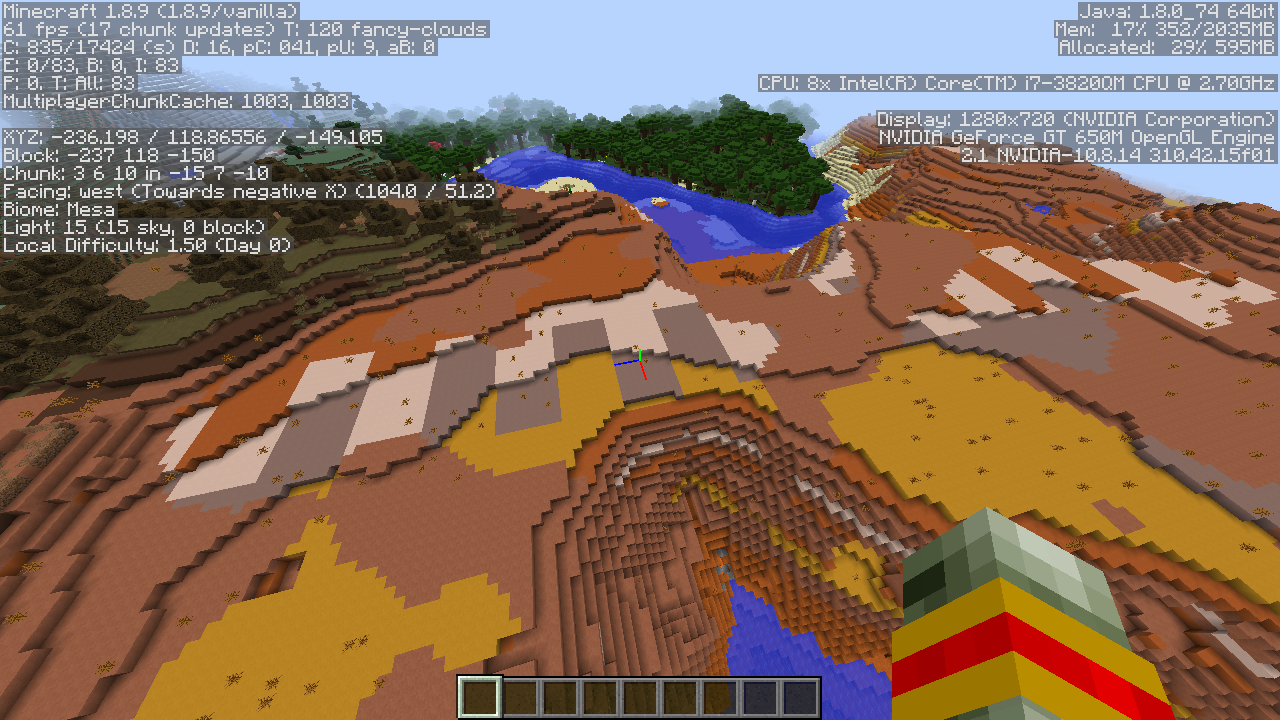
As can hopefully be seen in my screenshots, obvious straight lines can be seen through the stained/hardened clay.
This may be only in mesa plateau, or that may simply be the easiest place to see it as it is more flat. The seed I used was "mesa" for those examples, but I've tried several seeds and found signs of the same thing in every mesa I've visited.
Sometimes it can be less obvious due to less contrasting colors at the surface level. As can be seen from mesa2 , where I've put wool to indicate the chunk boundaries, these lines are chunk related. It seems that there's a chunk-sized area where one "height" of colors meets another (strip going north-south) and in this strip the "sides" alternate every chunk, producing these "fingers" going east-west. On one side of the "strip" the colors are assigned by Y one off from the other side. In mesa3
 and mesa4
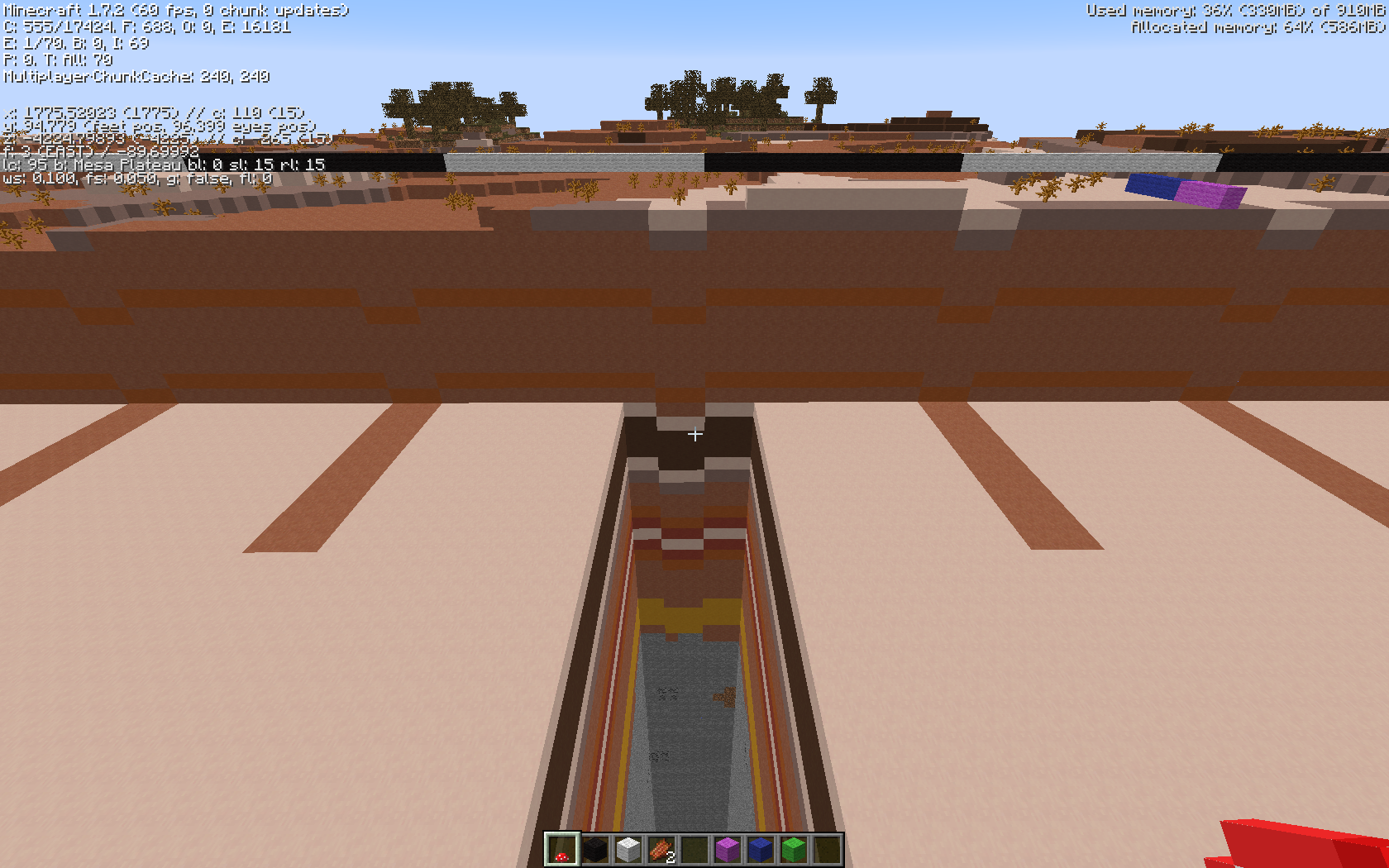 you can see that the effect isn't just on the surface, and goes all the way down in the clay.
Code analysis
Based on 1.11.2 decompiled using MCP 9.35 rc1
It looks like the method net.minecraft.world.biome.BiomeMesa.getBand(int, int, int) is causing this by offsetting the used clay band index.
Linked Issues
Attachments14


![[Mod] redstonehelper](../../../data/avatars/users/10122.svg)




Created Issue:
Stained/hardened clay generated in mesa has bad color assignment ("chunk lines")
I've looked through all the tickets related to mesa or clay, and can't find this, but I'm surprised it hasn't been reported before as it can be very obvious.
As can hopefully be seen in my screenshots, obvious straight lines can be seen through the stained/hardened clay.
This may be only in mesa plateau, or that may simply be the easiest place to see it as it is more flat. The seed I used was "mesa" for those examples, but I've tried several seeds and found signs of the same thing in every mesa I've visited. Sometimes it can be less obvious due to less contrasting colours at the surface level. As can be seen from mesa2, where I've put wool to indicate the chunk boundaries, these lines are chunk related. It seems that there's a chunk-sized area where one "height" of colors meets another (strip going north-south) and in this strip the "sides" alternate every chunk, producing these "fingers" going east-west. On one side of the "strip" the colors are assigned by Y one off from the other side. In mesa3 and mesa4 you can see that the effect isn't just on the surface, and goes all the way down in the clay.
Attachments4
![[Mod] Ezekiel (ezfe)](../../../data/assets/gravatar/ezekielelin.jpeg)
Stained/hardened clay generated in mesa has bad color assignment ("chunk lines")Mesa clay layer distribution causing repeating rough edges and lines on surface
is duplicated by
is duplicated by
![[Mod] Neko](../../../data/avatars/users/92901.png)
is duplicated by

![[Mod] Michael Wobst](../../../data/avatars/users/37868.png)
I've looked through all the tickets related to mesa or clay, and can't find this, but I'm surprised it hasn't been reported before as it can be very obvious.
As can hopefully be seen in my screenshots, obvious straight linescanbe seen through the stained/hardened clay.
This may be only in mesa plateau, or that may simply be the easiest place to see it as it is more flat. The seed I used was "mesa" for those examples, but I've tried several seeds and found signs of the same thing in every mesa I've visited.Sometimes it can be less obvious due to less contrasting colours at the surface level. As can be seen from mesa2, where I've put wool to indicate the chunk boundaries, these lines are chunk related. It seems that there's a chunk-sized area where one "height" of colors meets another (strip going north-south) and in this strip the "sides" alternate every chunk, producing these "fingers" going east-west. On one side of the "strip" the colors are assigned by Y one off from the other side. In mesa3 and mesa4 you can see that the effect isn't just on the surface, and goes all the way down in the clay.As can hopefully be seen in my screenshots, obvious straight lines can be seen through the stained/hardened clay.
This may be only in mesa plateau, or that may simply be the easiest place to see it as it is more flat. The seed I used was "mesa" for those examples, but I've tried several seeds and found signs of the same thing in every mesa I've visited.
Sometimes it can be less obvious due to less contrasting colors at the surface level. As can be seen from mesa2, where I've put wool to indicate the chunk boundaries, these lines are chunk related. It seems that there's a chunk-sized area where one "height" of colors meets another (strip going north-south) and in this strip the "sides" alternate every chunk, producing these "fingers" going east-west. On one side of the "strip" the colors are assigned by Y one off from the other side. In mesa3 and mesa4 you can see that the effect isn't just on the surface, and goes all the way down in the clay.
As can hopefully be seen in my screenshots, obvious straight lines can be seen through the stained/hardened clay.
This may be only in mesa plateau, or that may simply be the easiest place to see it as it is more flat. The seed I used was "mesa" for those examples, but I've tried several seeds and found signs of the same thing in every mesa I've visited.
Sometimes it can be less obvious due to less contrasting colors at the surface level. As can be seen from mesa2, where I've put wool to indicate the chunk boundaries, these lines are chunk related. It seems that there's a chunk-sized area where one "height" of colors meets another (strip going north-south) and in this strip the "sides" alternate every chunk, producing these "fingers" going east-west. On one side of the "strip" the colors are assigned by Y one off from the other side. Inmesa3 and mesa4 you can see that the effect isn't just on the surface, and goes all the way down in the clay.As can hopefully be seen in my screenshots, obvious straight lines can be seen through the stained/hardened clay.
This may be only in mesa plateau, or that may simply be the easiest place to see it as it is more flat. The seed I used was "mesa" for those examples, but I've tried several seeds and found signs of the same thing in every mesa I've visited.
Sometimes it can be less obvious due to less contrasting colors at the surface level. As can be seen from mesa2, where I've put wool to indicate the chunk boundaries, these lines are chunk related. It seems that there's a chunk-sized area where one "height" of colors meets another (strip going north-south) and in this strip the "sides" alternate every chunk, producing these "fingers" going east-west. On one side of the "strip" the colors are assigned by Y one off from the other side. In mesa3and mesa4
As can hopefully be seen in my screenshots, obvious straight lines can be seen through the stained/hardened clay.
This may be only in mesa plateau, or that may simply be the easiest place to see it as it is more flat. The seed I used was "mesa" for those examples, but I've tried several seeds and found signs of the same thing in every mesa I've visited.
Sometimes it can be less obvious due to less contrasting colors at the surface level. As can be seen from mesa2, where I've put wool to indicate the chunk boundaries, these lines are chunk related. It seems that there's a chunk-sized area where one "height" of colors meets another (strip going north-south) and in this strip the "sides" alternate every chunk, producing these "fingers" going east-west. On one side of the "strip" the colors are assigned by Y one off from the other side. In mesa3As can hopefully be seen in my screenshots, obvious straight lines can be seen through the stained/hardened clay.
This may be only in mesa plateau, or that may simply be the easiest place to see it as it is more flat. The seed I used was "mesa" for those examples, but I've tried several seeds and found signs of the same thing in every mesa I've visited.
Sometimes it can be less obvious due to less contrasting colors at the surface level. As can be seen from mesa2
As can hopefully be seen in my screenshots, obvious straight lines can be seen through the stained/hardened clay.
This may be only in mesa plateau, or that may simply be the easiest place to see it as it is more flat. The seed I used was "mesa" for those examples, but I've tried several seeds and found signs of the same thing in every mesa I've visited.
Sometimes it can be less obvious due to less contrasting colors at the surface level. As can be seen from mesa2you can see that the effect isn't just on the surface, and goes all the way down in the clay.The bug
As can hopefully be seen in my screenshots, obvious straight lines can be seen through the stained/hardened clay.
This may be only in mesa plateau, or that may simply be the easiest place to see it as it is more flat. The seed I used was "mesa" for those examples, but I've tried several seeds and found signs of the same thing in every mesa I've visited.
Sometimes it can be less obvious due to less contrasting colors at the surface level. As can be seen from mesa2Code analysis
Based on 1.11.2 decompiled using MCP 9.35 rc1
It looks like the method net.minecraft.world.biome.BiomeMesa.getBand(int, int, int) is causing this by offsetting the used clay band index.
![[Mod] tryashtar](../../../data/avatars/users/41963.png)

Is this still a concern in the latest Minecraft version 14w03b? If so, please update the affected versions in order to best aid Mojang ensuring bugs are still valid in the latest releases/pre-releases.
Confirmed.
Seed "mesa", coordinates 1756 133 -4187
Obviously, still in 07a
Is this still a concern in the latest Minecraft version 14w20b? If so, please update the affected versions in order to best aid Mojang ensuring bugs are still valid in the latest releases/pre-releases.
Yes.
This is still an issue in 14w26c.
Confirmed for 1.8-pre3, attached screenshots of seed 217597037560031916 at coordinates 909 120 15 and 996 112 -200.
Confirmed for 1.8, I suggest renaming the ticket to something like "Mesa clay layer distribution causing rough edges and lines on surface".
Seed: 7683360502751022699
Also in 1.9 pre-4
Is this still an issue in the latest snapshot 16w44a? If so please update the affected versions.
This is an automated comment on any open or reopened issue with out-of-date affected versions.
Confirmed for 1.11 pre1
Is this still an issue in the latest 1.13 development snapshot?
This issue seems to be fixed now as of Snapshot 18w20c